If you're not at Portsmouth, the degree classification calculator covers the standard UK percentage-based system most other universities use instead.
How Portsmouth classifies your degree differently
Portsmouth weights Level 5 (second year) and Level 6 (third year) in a 40:60 ratio — not an even split and not a simple "final year counts more" rule of thumb, but a specific published ratio. Before that weighting is applied, your worst 20 credits at Level 5 and your worst 20 credits at Level 6 are each discounted, so one weak module doesn't drag down your whole result the way it would on a generic calculator.
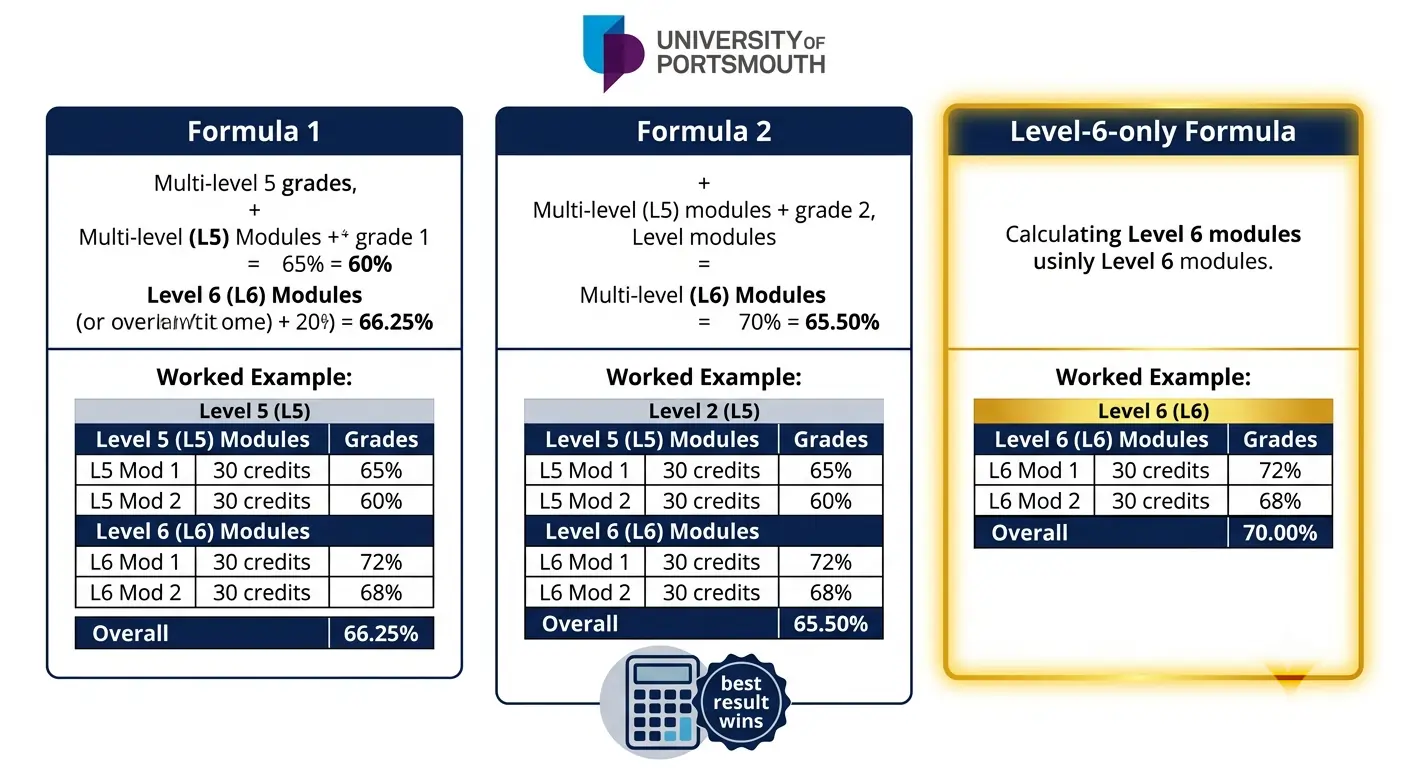
Portsmouth then checks your result against three separate formulae, set out in its regulations, and awards whichever classification comes out highest:
- The 40:60 weighted mean of your discounted Level 5 and Level 6 credits
- Your discounted Level 6 credits alone, with no Level 5 contribution at all
- Whichever classification more than half of your combined discounted credits individually sit in
That third option means a strong spread of individual module results can sometimes earn you a higher classification than your raw weighted average would suggest.
Worked example: when Level 6 alone gives a better result
Say your Level 5 modules (six at 20 credits each) scored 75, 72, 68, 65, 60, and 55. Discounting the worst (55) leaves 75, 72, 68, 65, 60 — averaging 68%. Your Level 6 modules scored 71, 73, 69, 70, 68, and 40. Discounting the worst (40) leaves 71, 73, 69, 70, 68 — averaging 70.2%.
Since Portsmouth awards whichever formula gives the highest classification, this student gets a First, even though their overall weighted average alone would only have supported a 2:1.
Why this trips people up enough to ask for help
This isn't a hypothetical concern; Portsmouth students regularly post their own module breakdowns on UK student forums asking the community to work out which of the three formulas actually applies to them, because doing it by hand across three separate calculations is easy to get wrong and easy to miss the formula that would have given a better result.
That's the specific gap this calculator is built to close: running all three formulae automatically, rather than leaving you to spot the best one yourself.
What's discounted, and what isn't
The worst-20-credits discount applies separately at each level; it's not one combined discount across both years. Pass/fail modules are a completely separate matter: they don't count toward your classification or your weighted average at all, discounted or otherwise, so don't include them as a row in this calculator.
If 20 or more of your Level 6 credits came from recognised prior learning or pass/fail modules, Portsmouth's regulations give the Board of Examiners discretion to review your classification outside the standard formulae; that's a case-by-case decision, not something a calculator can model, so it's worth raising directly with your department if it applies to you.
Changes from September 2026
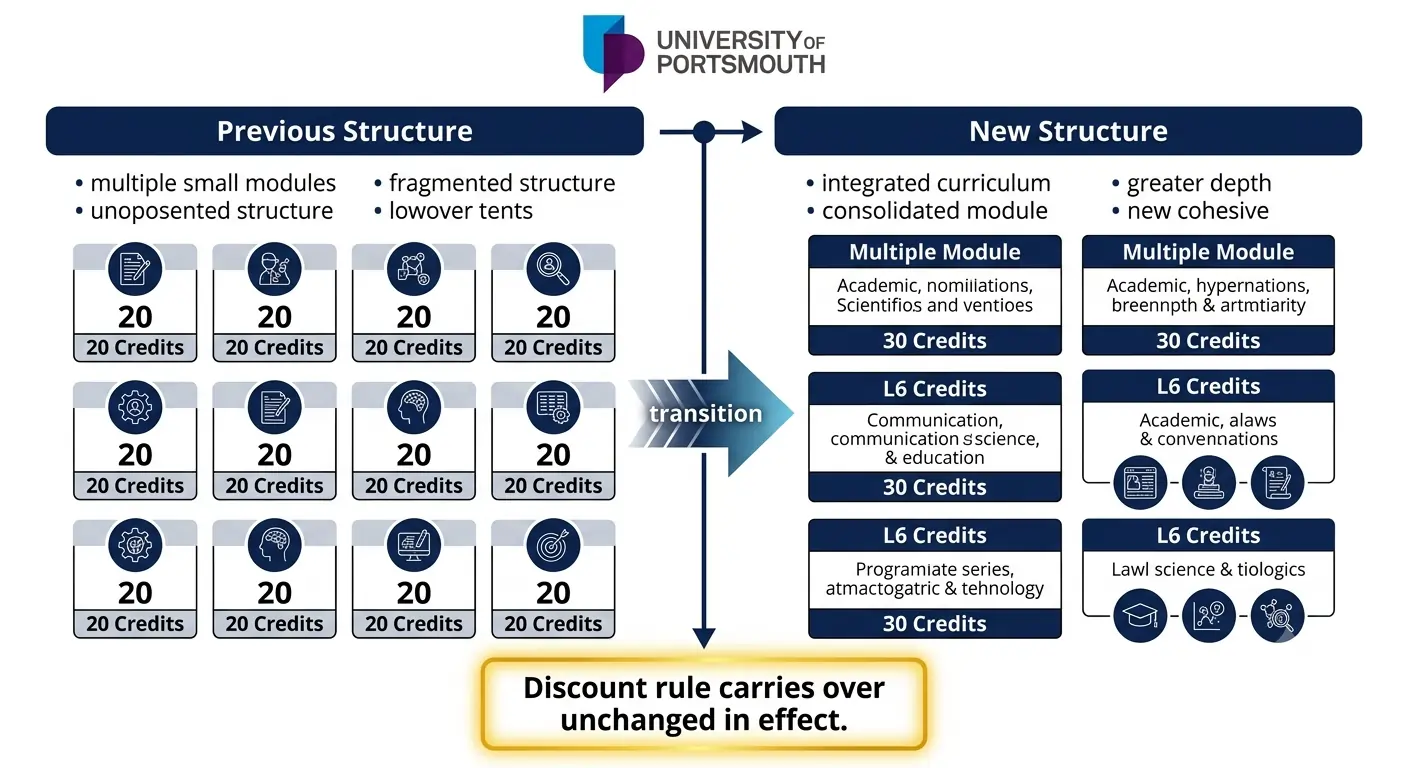
Portsmouth is moving undergraduate modules to credit sizes based on multiples of 30, replacing the older structure. According to the university's own published update, the discount rule continues in equivalent effect under the new structure, so if you're a continuing student or joining from the 2026/27 academic year, the underlying classification method described above still applies, just expressed in the new credit sizes.
Portsmouth's own Grade Point Average
Separately from your classification, Portsmouth also calculates and reports a Grade Point Average to two decimal places, as a complementary measure of your overall performance. This is a Portsmouth-specific metric, not the same thing as a US 4.0 GPA — if you need your result translated for a US application instead, the UK grade to GPA conversion calculator handles that conversion.
Studying for a master's at Portsmouth?
The classification method above applies to undergraduate honours degrees specifically. Portsmouth master's courses are assessed differently, typically against Distinction/Merit/Pass bands rather than the Level 5/6 honours formulae; check your specific course handbook for the exact criteria, since postgraduate regulations sit outside the undergraduate rules described on this page.
Frequently asked questions
Is this the official Portsmouth calculation method?
It's built directly from Portsmouth's published Examination and Assessment Regulations — the 40:60 weighting, the worst-20-credit discount, and the three-formula "highest wins" approach are all real, sourced rules, not an approximation. For a borderline or disputed result, confirm directly with Academic Registry.
What if one of my modules is pass/fail?
Leave it out of the calculation entirely — pass/fail modules don't count toward classification or the weighted average, discounted or otherwise.
Does this work for joint honours courses?
The same three-formula structure applies, but how credits split across your two subjects can affect which modules count toward classification. If you're on a joint honours course and unsure, check with your course team before relying on the result.
What changed for students starting in 2026?
Module credit sizes are moving to multiples of 30, but the discount rule carries over in equivalent effect, so the classification method itself is unchanged for both continuing and new students.
Can I just use the generic degree classification calculator instead?
Not reliably — the generic degree classification calculator assumes a single weighted-average formula. Portsmouth's three-formula, discount-adjusted system can produce a different, often more favourable, result, which this page is built specifically to capture.