It's a different job from working out the percentage itself: if you don't have your average yet, get that first from the university grade calculator or the credit-weighted calculator, then come back here to see what it means.
If your actual question is "What average do I need for a 2:1," that's a target calculation rather than a conversion; the final and overall grade calculator is built for that instead.
The UK degree classification bands
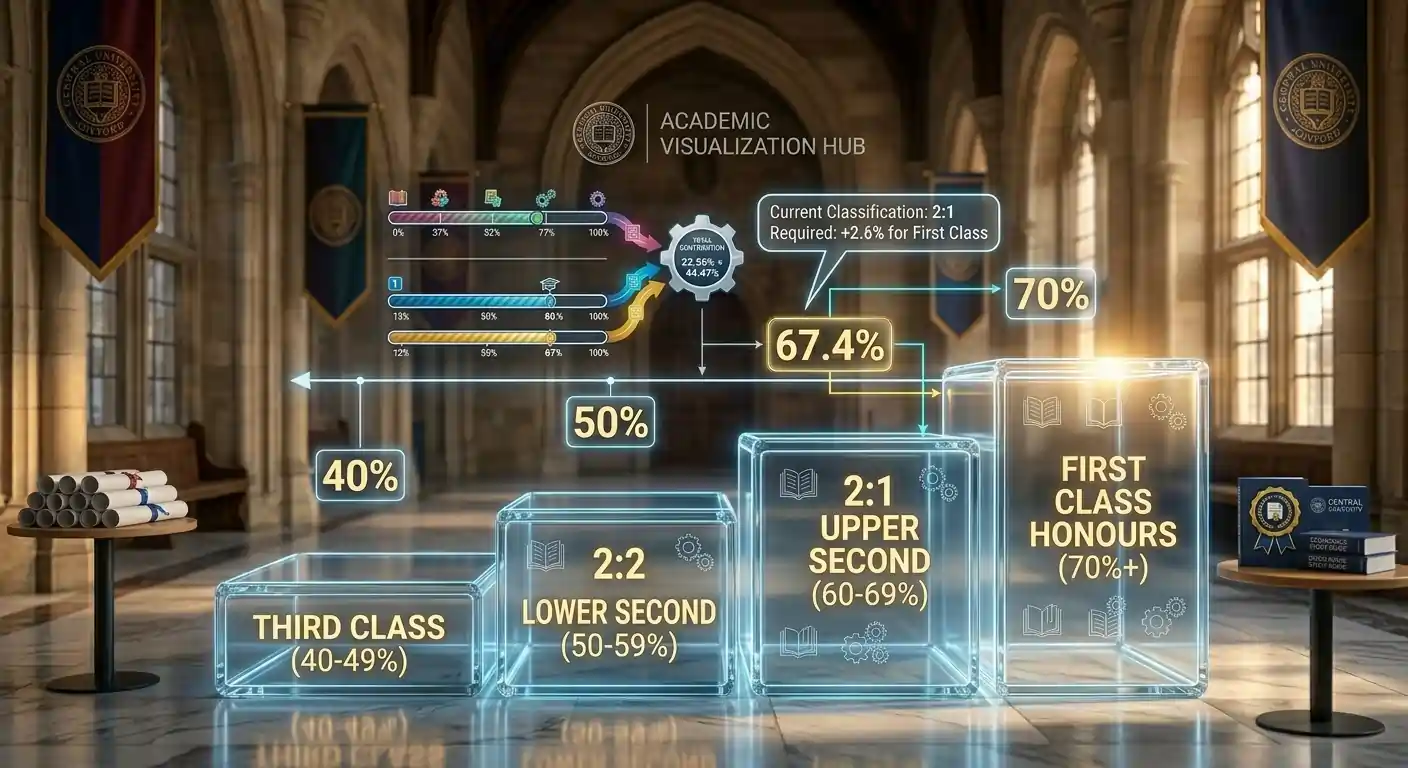
UK undergraduate degrees are almost universally classified as first-class honours (70%+); upper second-class honours, written as 2:1 (60–69%); lower second-class honours, written as 2:2 (50–59%); and third-class honours (40–49%).
You'll sometimes see "2.1" or "2.2" used instead of "2:1" and "2:2"; it's the same thing, just written without the colon, and it's how a lot of people actually search for this rather than how it's formally printed on a transcript. First-Class is properly written as "1st," not "1:1," but "1:1" gets searched for constantly, almost certainly by analogy with "2:1" and "2:2," even though it isn't the official notation. If that's what brought you here: 1:1 and 1st mean the same thing.
Why a 70% in the UK isn't like a 70% anywhere else
This is the bit that confuses almost everyone coming from a different grading system, including UK students who've only ever seen their own university's marking. One academic, describing how they were taught to mark exam papers at a UK university, put it roughly like this: a paper with no errors, covering everything required, earns close to 70%, just enough for a first. To score meaningfully higher than that, the work needs to show original thought or genuine depth beyond what was taught, not just correct execution of it.
That's a deliberately different philosophy from grading systems where 90%+ is routine for strong students. It's why a 70% average in a UK degree is something to be proud of rather than a sign you're underperforming and why the percentage bands above look "low" if you're mentally comparing them to a different system. If you need to translate a UK result into something like a US GPA for an application, the UK grade to GPA conversion calculator covers that translation directly.
Worked example: how close are you to the next boundary?
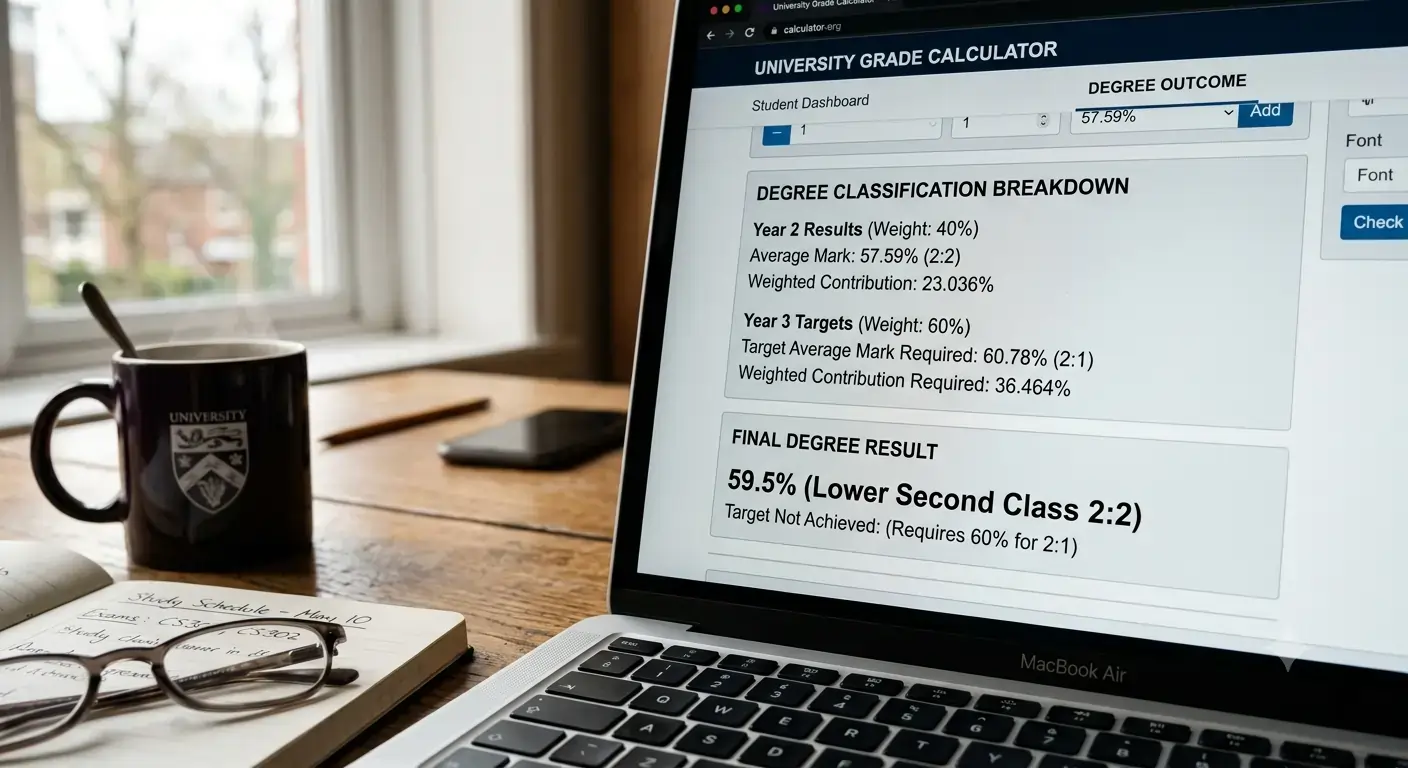
Say your current average is 58.7%. The 2:1 boundary at most universities sits at 60%, so you're 1.3 percentage points short of it: close enough that it's worth understanding how your university actually handles borderline cases rather than assuming a strict cut-off. The same logic applies at every boundary on the scale, not just the 2:1 line: being 1.3 points under a First-Class threshold or a 2:2 threshold raises exactly the same question about rounding policy.
Borderline cases: how credit-distribution rounding works
Many UK universities don't apply a hard percentage cut-off at all. Instead, they look at how your credits are spread across grade bands: if a defined share of your credits (commonly around half, though this varies by institution) falls within the band above your raw average, your classification can be rounded up to that band even though your straight percentage average sits just below it.
As an illustrative example of how this kind of scheme tends to work — not a rule that applies everywhere — a student averaging 58.7% overall but with the majority of their final-year credits individually marked at 60% or above might be rounded up to a 2:1 despite the raw average sitting under the boundary. The exact threshold, and whether a university uses this kind of scheme at all, is published in your assessment regulations or course handbook, and it's worth checking directly rather than assuming either a strict cut-off or automatic rounding.

Don't have your percentage yet?
This page only converts a percentage you already know; it doesn't calculate one for you. If you're still adding up marks across modules or years, start with the university grade calculator for a flexible grid or the credit-weighted calculator if your university structures things by Level 4/5/6 credits. Once you've got a percentage, bring it back here to see what it means.
Frequently asked questions
What's the difference between this and the main grade calculator?
The main calculator works out your percentage average. This page takes that percentage and tells you which classification band it falls into and how close you are to the boundaries on either side.
What does "1:1" mean? Is that the same as a first?
Yes. The correct UK notation for First-Class Honours is "1st," but a lot of people search and refer to it as "1:1" by analogy with 2:1 and 2:2. They mean the same thing.
Will my university round 59.5% up to a 2:1?
It depends entirely on your university's specific policy. Some apply a strict percentage cut-off; many look at credit distribution instead, which can round a borderline average up even without hitting the raw percentage boundary. Check your assessment regulations rather than assuming either way.
What if I'm right on a boundary?
Being within a percentage point or so of a boundary is exactly the situation where your university's specific rounding or compensation policy matters most. The calculator will flag when you're in that zone — treat the result as "likely in the borderline zone, check your regulations," not as a guaranteed classification.
Can this tell me what average I need for a 2:1?
No — that's a target/reverse calculation rather than a conversion. Use the final and overall grade calculator and set your target to the percentage boundary for the classification you want.