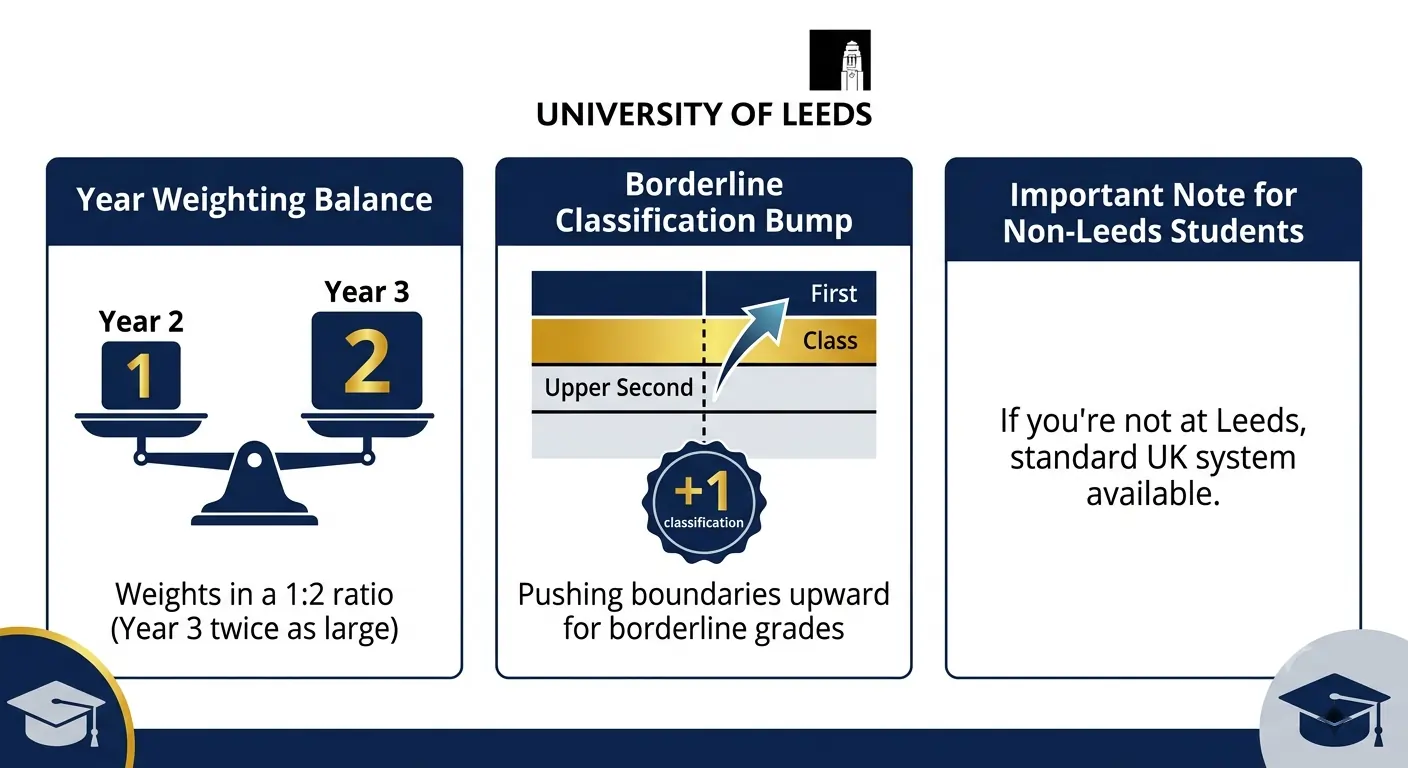
If you're not at Leeds, the degree classification calculator covers the standard system most other universities use.
How Leeds weights your degree
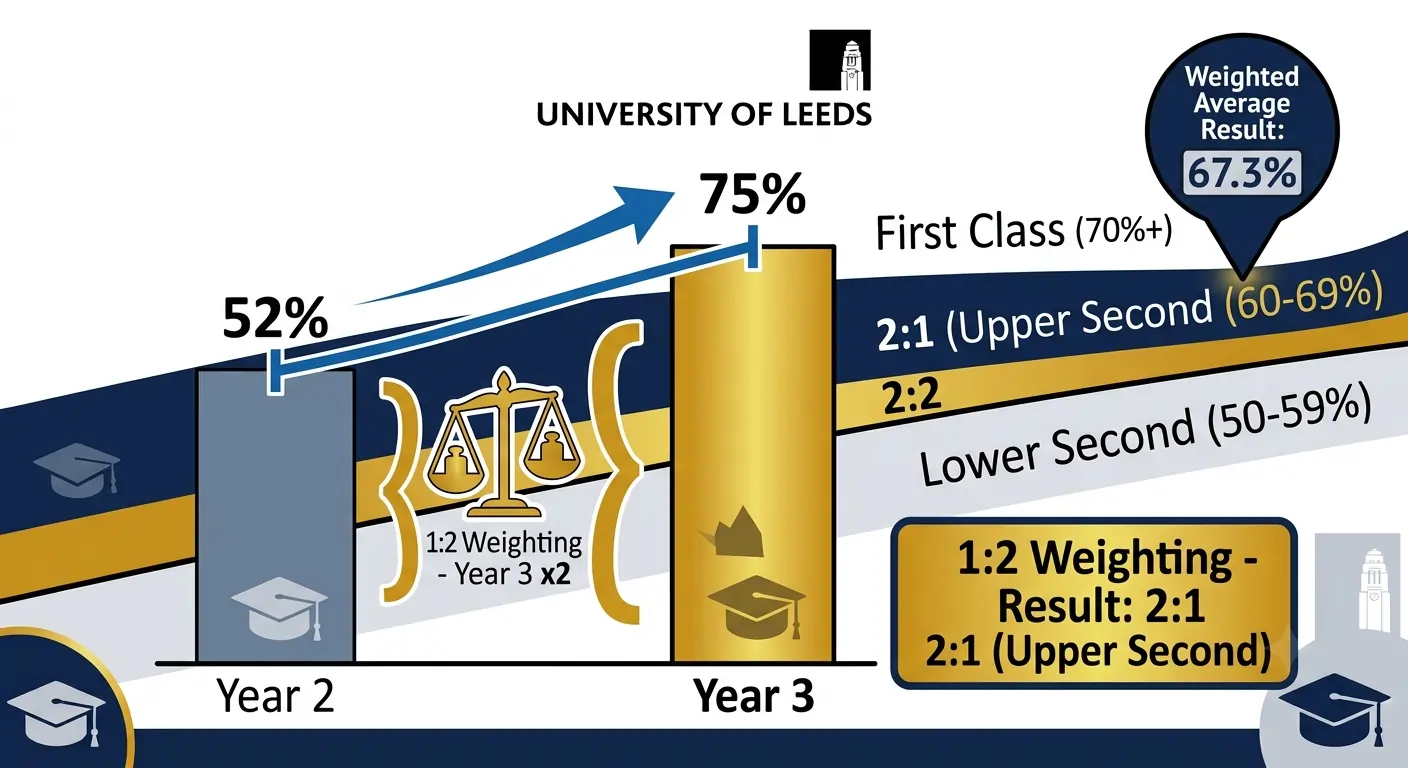
For students who started in 2022/23 or later, Leeds uses a fixed 1:2 weighting between programme years 2 and 3 — your third year counts twice as much as your second year, with no flexibility either way.
This replaced an older system that let students take whichever of a 1:1 or 1:2 split gave the better result; that change was approved by the university's Senate in 2022 and only applies going forward, so if you started before then, check whether the older flexible system still applies to you.
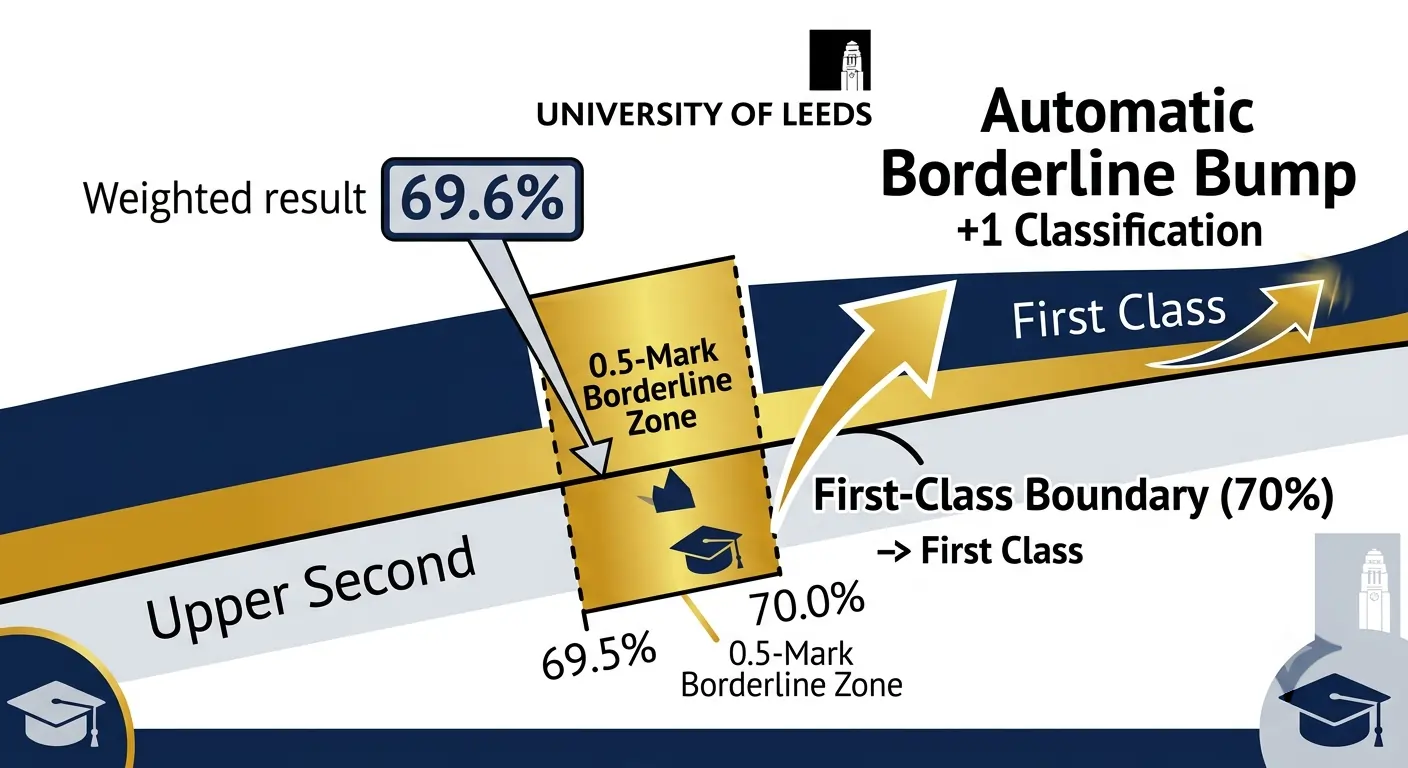
Classification thresholds follow the standard UK bands — First-Class at 70%+, Upper Second (2:1) at 60–69%, Lower Second (2:2) at 50–59%, Third-Class at 40–49% — but Leeds adds one genuinely useful rule on top: if your weighted average falls within 0.5 marks of the boundary above you, you're automatically awarded the higher classification, no appeal needed.
Worked example: when the 0.5-mark rule changes your result
Say your Year 2 average was 68% and your Year 3 average was 70.4%. Using the 1:2 weighting:
On its own, 69.6% sits in the Upper Second (2:1) band. But it's only 0.4 marks short of the 70% First-Class threshold — within the 0.5-mark borderline zone — so under Leeds' own rule, this result is automatically bumped up to a First, with no discretionary appeal required.
Minimum credit requirements and back-counting
To be eligible for a bachelor's with classified honours, you need to have passed a minimum of 100 credits at each of FHEQ Levels 4, 5, and 6 (broadly, your first, second, and third years).
If you've picked up more credits than required at a higher level, Leeds allows those excess credits to "back-count" against a shortfall at a lower level, so a strong run of extra credits in third year can help cover a gap from earlier in your degree, rather than that shortfall simply blocking your award.
How non-numeric marks are handled
Not every result on your transcript is a straightforward number, and Leeds has specific rules for each case when calculating your classification average. An "AB" (absent) mark counts as a zero if that module counts toward classification. A "P" (plain pass) mark is excluded from the classification average entirely, rather than counted at any specific value.
A module marked "WD" (withdrawn) shows blank on your transcript and doesn't factor into the calculation. If you see a "V" suffix against a passed module, a default mark of 39 (undergraduate) or 49 (postgraduate) is used for classification purposes, even though it won't appear that way on your official transcript. None of this is guesswork — it's set out directly in Leeds' own published guidance on explanations of marks.
What this calculator doesn't cover
A handful of Leeds programmes use different weightings: Integrated Masters and Bachelor's degrees are weighted 1:2:2 across years 2, 3, and 4 rather than the standard 1:2; some 2+2 programme structures use a 0:1:2 weighting instead. Programmes with professional accreditation requirements (such as those tied to the Law Society or General Medical Council) may follow entirely different rules set by their school.
This calculator is built around the standard Bachelor's with Classified Honours formula. If your programme falls into one of these other categories, check your specific programme specification or use Leeds' own official classification calculators, published as Excel spreadsheets for each award type.
A real example of why this matters
A Leeds student's experience, shared in a long-running student forum thread, makes the point well: someone who scored 52–53% in the second year went on to score well enough in the third year to land a 2:1 overall, specifically because the heavier weighting on the final year gave their improvement real leverage.
Second-year results that look disappointing don't necessarily predict your final classification under a system that weights your final year this heavily.
Frequently asked questions
Does this apply to me if I started before 2022?
Possibly not in full — Leeds moved to the fixed 1:2 weighting for students starting from 2022/23 onward. If you started earlier, you may still be on the previous system, which allowed a more flexible 1:1 or 1:2 split depending on which gave the better result. Check with your school if you're unsure which applies to you.
What's the 0.5-mark borderline rule, exactly?
If your final weighted average is within 0.5 marks of the classification boundary above you, Leeds automatically awards the higher classification; you don't need to request it or appeal for it.
Does this work for integrated master's degrees?
Not directly. Integrated Master's and Bachelor's programmes typically use a 1:2:2 weighting across years 2, 3, and 4 rather than the 1:2 weighting this calculator is built around. Check your programme specification for the exact figures.
What if my year abroad or industrial placement counts toward my degree?
Full-year placements or study abroad that count toward classification are typically single-weighted rather than following the standard year weighting. This calculator doesn't model that case; check your specific programme rules.
Can I just use the generic degree classification calculator instead?
Not reliably — the generic degree classification calculator doesn't apply Leeds' fixed 1:2 weighting or its automatic 0.5-mark borderline rule, both of which can change your result.