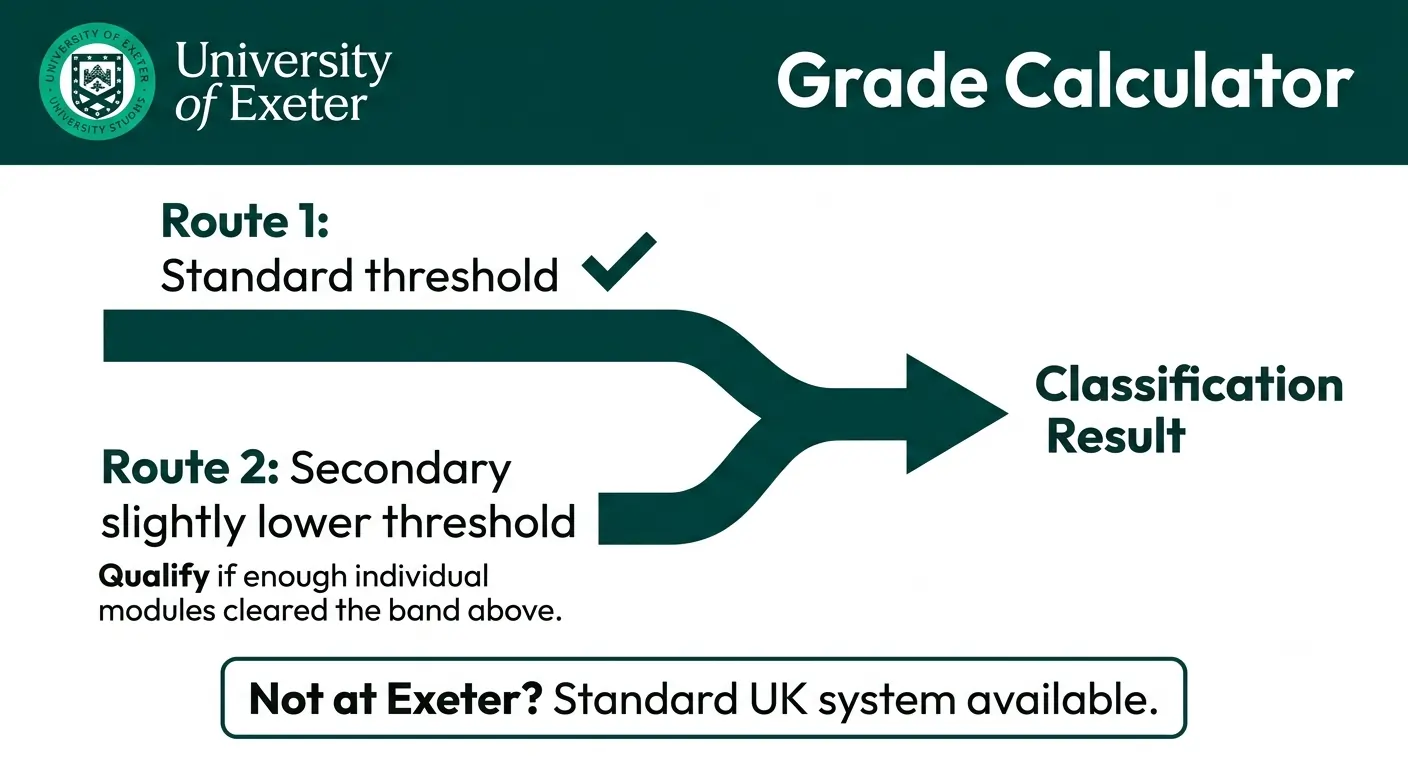
If you're not at Exeter, the degree classification calculator covers the standard system most other universities use instead.
How Exeter weighs your degree
For a standard three-year bachelor's, Exeter weights Stage 2 and Stage 3 in a 1:2 ratio; your final year counts twice your second year, calculated to two decimal places with no rounding at any point.
Other course structures use different ratios entirely: two-year Bachelor's degrees use 1:2 between Stage 1 and Stage 2; four-year integrated Master's degrees use 2:3:4 across Stages 2, 3, and 4; and courses with a year abroad or industrial placement use yet another set of ratios depending on which year the placement falls in (2:1:4 if it's in Stage 3, for example).
This calculator is built around the standard three-year structure; check your own programme specification if you're on one of these other course types.
The dual-threshold qualifying rule
This is the part that makes Exeter genuinely different from a simple percentage cut-off. For each classification, there are two separate ways to qualify, and you only need to clear one of them:
- The straightforward route: your overall weighted mark clears the standard threshold on its own — 69.50% for a First, 59.50% for a 2:1, and 49.50% for a 2:2.
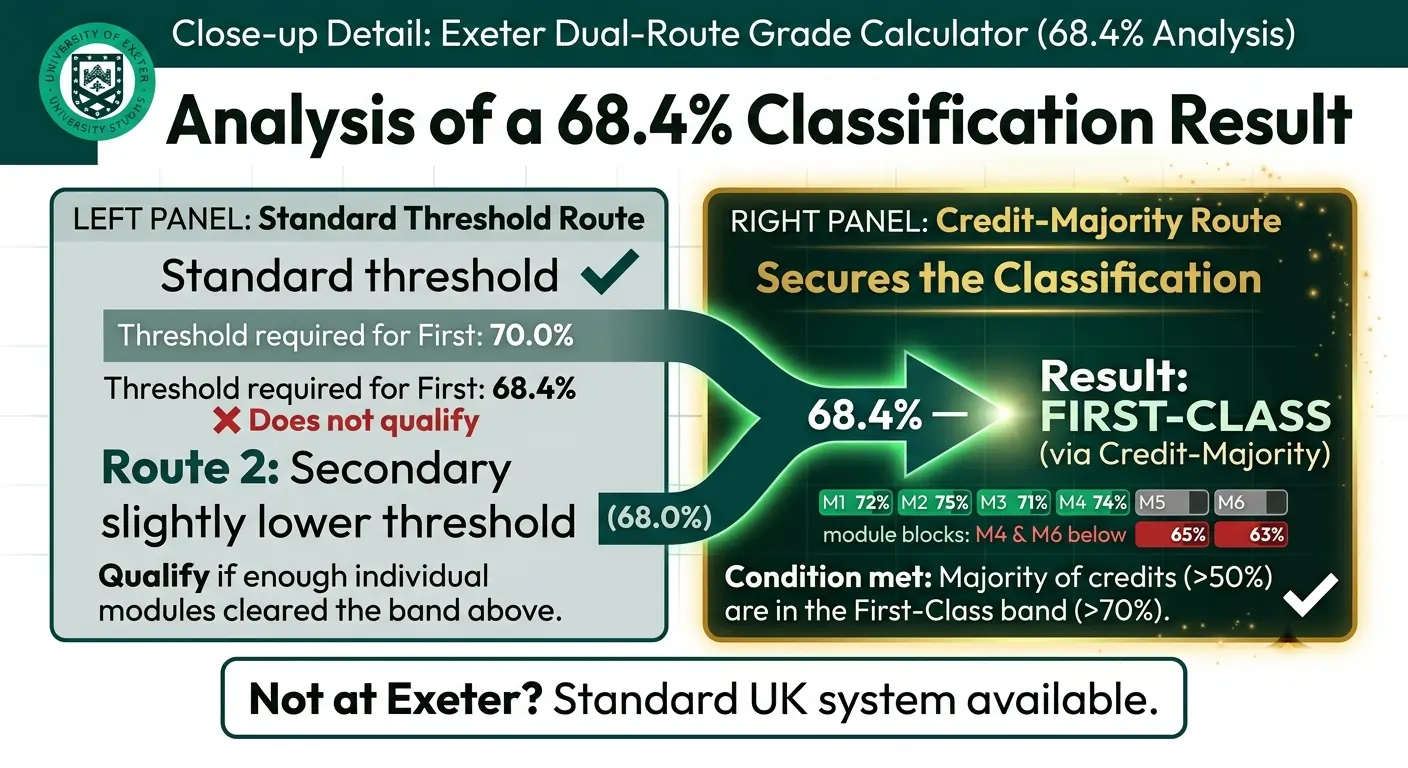
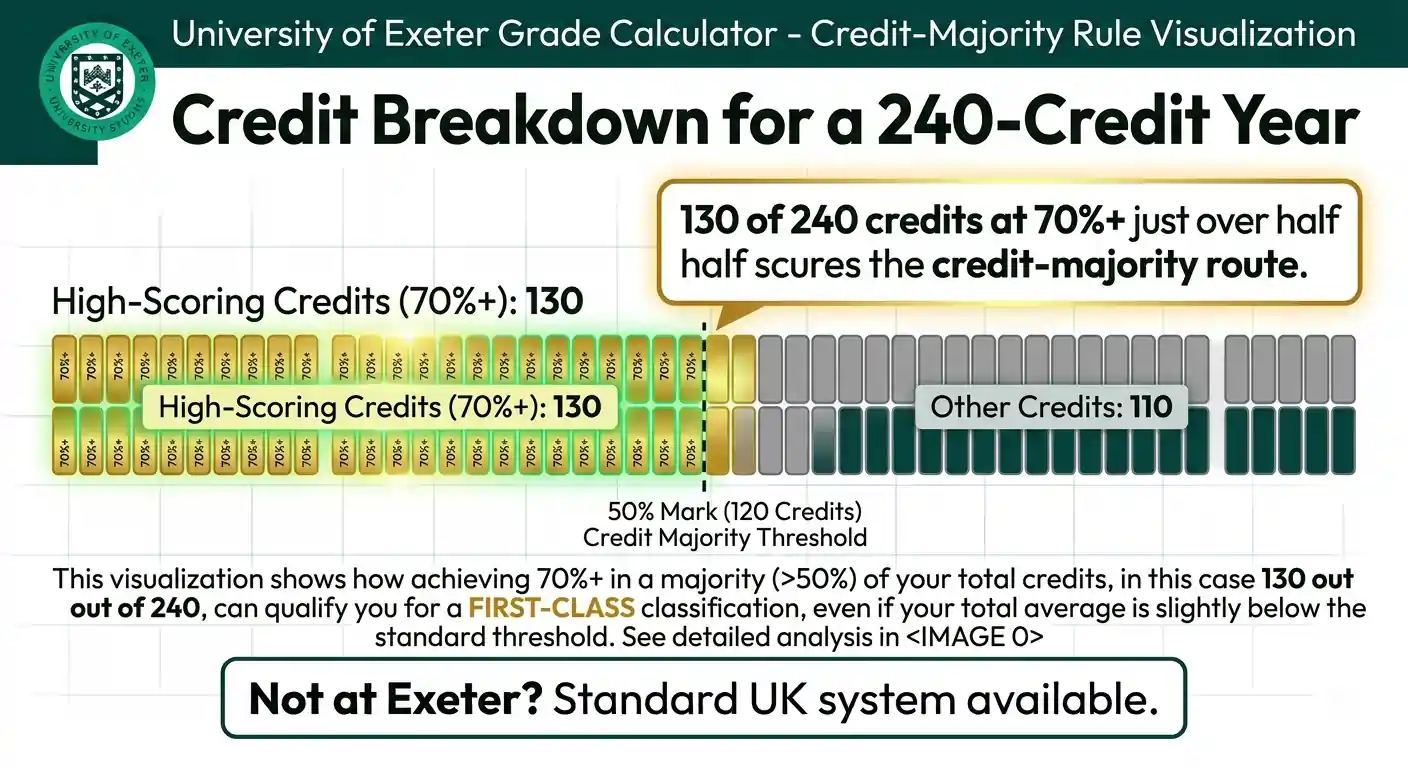
- The credit-majority route: your overall weighted mark clears a slightly lower threshold — 68.00% for a First, 58.00% for a 2:1, 48.00% for a 2:2 — and at least half your credits, by value, were individually marked at or above the band above (70%+ for a First, 60%+ for a 2:1, and so on).
You're awarded the higher of the two routes you actually qualify through.
Worked example: qualifying through the credit-majority route
Say your overall Stage 2/3 weighted mark comes to 68.4%. That's below the straightforward 69.50% threshold for a First, so on a simple percentage basis you'd land in the upper second band.
But check the second route: your mark is at least 68.00% (it is), and if 130 of your 240 classified credits — just over half — were individually marked 70% or higher, you'd satisfy the credit-majority condition too. That means you qualify for a First through the second route, even though your straight average alone wasn't enough.
Why this matters more than it might look like
A mark of 68.4% might read as "just missing a first" if you only look at the headline percentage, but a strong, consistent set of individual module results can carry you over the line through the credit-majority route even when your overall average sits a full point below the standalone threshold.
It's worth checking both routes before assuming your overall percentage is the final word, which is exactly why a calculator that only does a simple weighted average isn't enough for Exeter students.
Pass thresholds and condonement
The overall pass/fail threshold for an Exeter undergraduate award is an average of 40.00%; below that, you don't qualify for a classified award at all, regardless of which route you might otherwise have used.
Exeter also operates a "condonement" system, which allows a limited number of failed credits to still count toward your award rather than blocking it outright, provided those credits are genuinely contributing to the qualification you're working towards.
If you're relying on condonement, the specific limits depend on your programme's rules, so this calculator treats all entered marks as already confirmed and passed rather than trying to model condonement itself.
What this calculator doesn't cover
Exeter's Assessment, Progression, and Awarding Committees (APAC) retain discretion for genuinely borderline cases beyond the formal rules above; if your result sits right on a boundary, the committee can look at your full spread of results and award the higher classification on an anonymised basis, independent of the dual-threshold rule itself.
This calculator applies the published formal rules; it can't model that kind of case-by-case discretionary review. Year-abroad, placement-year, and integrated Master's weightings also aren't included; those use different stage ratios entirely, noted above.
Frequently asked questions
Why are there two thresholds for each classification?
So a strong spread of individual high module marks can secure a classification even if your overall weighted average falls just short of the standalone threshold. You qualify if you clear either route.
Does this work for integrated Master's degrees?
Not directly — four-year integrated Master's programmes at Exeter use a 2:3:4 weighting across Stages 2, 3, and 4, rather than the 1:2 two-stage weighting this calculator is built around.
What if I have a year abroad or placement year?
Exeter applies a different weighting ratio depending on which stage your year out falls in (for example, 2:1:4 if it's in Stage 3). This calculator doesn't model those ratios — check your specific programme specification.
Is the credit-majority route automatic?
Yes, in the sense that it's a formal published rule, not discretionary — if you meet both conditions of that route, you qualify for the classification regardless of which route gives a "neater" headline percentage.
Can I just use the generic degree classification calculator instead?
Not reliably — the generic degree classification calculator only checks a single threshold per boundary and would miss the credit-majority route that can change a result like the worked example above.
What happens if I'm below the 40% pass threshold?
You wouldn't qualify for a classified award at all, regardless of which route would otherwise apply, unless condonement rules allow a limited number of failed credits to still count toward the qualification. That depends on your specific programme rules.