
This guide covers the structure, then shows where it actually differs in practice.
The basics: levels, years, and totals
UK undergraduate degrees are built from credits organised into FHEQ levels, which broadly map to academic years: Level 4 is normally your first year, Level 5 your second, Level 6 your third, and Level 7 a fourth year where one exists.
A standard three-year honours degree totals 360 credits (120 per year); four-year courses, integrated master's, or many Scottish degrees total 480. A typical taught master's totals 180 credits, usually 120 taught modules plus a 60-credit dissertation. For the full breakdown and a calculator built around this structure, see the credit-weighted grade calculator.
Module sizes aren't standardised either
How those credits are split into individual modules varies by institution. Middlesex builds its degrees from modules rated at 30 credits each, with a typical year made up of four such modules.
Portsmouth has historically used 20-credit modules but is moving to credit sizes based on multiples of 30 from September 2026 — a genuine structural change, not just a numbering tweak, and one the university has explicitly confirmed won't change the substance of its existing classification rules.
There's no single UK-wide standard for module size: 10, 15, 20, and 30-credit modules are all common, sometimes within the same institution depending on the course.
Minimum credit requirements: totals alone aren't enough
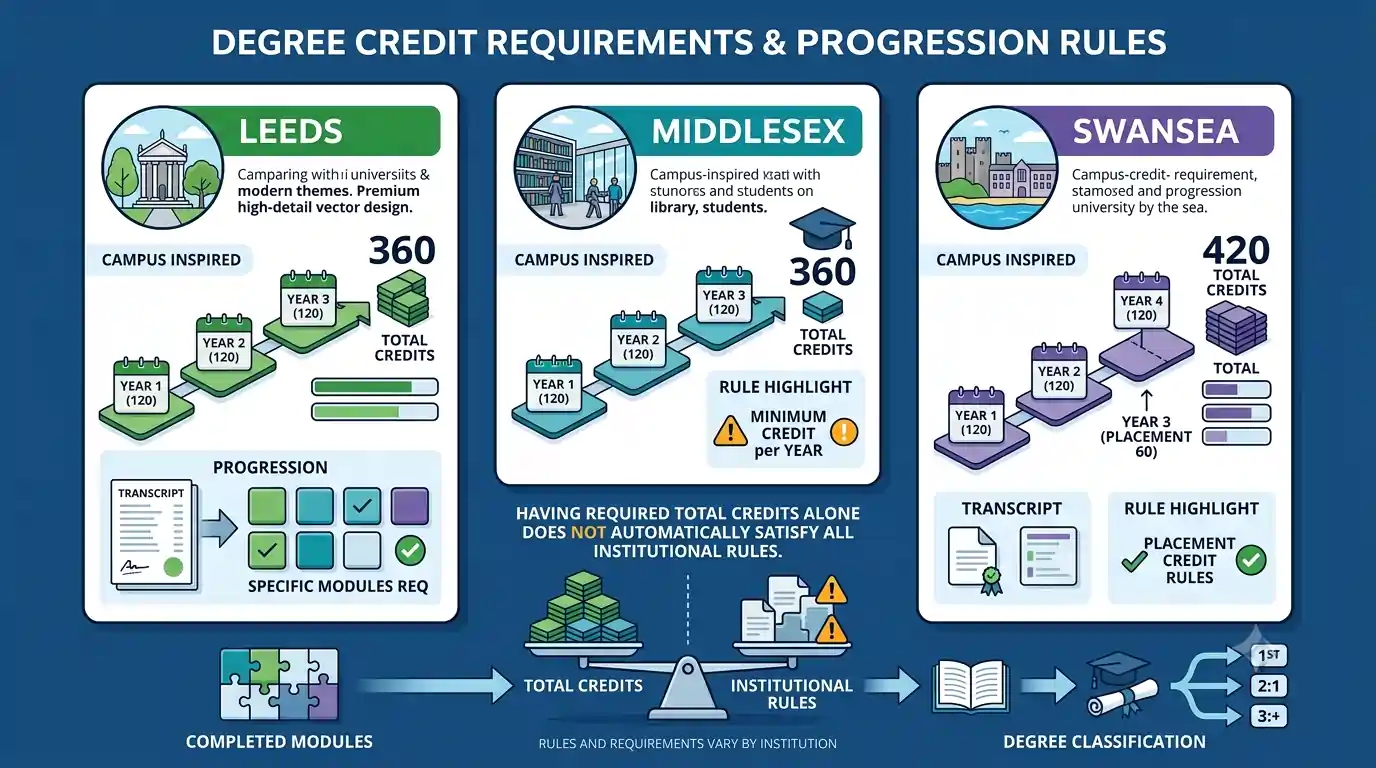
Having "enough" total credits isn't always sufficient on its own; several universities specify minimums at each level, not just overall. Leeds requires you to pass at least 100 credits at each of FHEQ Levels 4, 5, and 6 to be eligible for a bachelor's with classified honours, though excess credit at a higher level can "back-count" against a shortfall at a lower one.
Middlesex requires at least 360 credits at Level 4 and above for an Honours degree, of which at least 210 must be at Level 5 and above, and at least 120 of those at Level 6 and above. Swansea requires you to have pursued 240 credits (or 360 for an "advanced initial degree") within the specific years that contribute to classification; credit outside that window simply isn't considered, regardless of how much of it you have.
Worked example: when total credits aren't the full story
Say a Leeds student has accumulated 380 credits across their degree, comfortably above the 360 needed overall, but only 90 of those credits are at Level 6, ten short of the 100-credit minimum required at that specific level.
Back-counting only works in one direction: excess credit at a higher level can cover a shortfall at a lower one, not the other way round. So 20 extra credits sitting at Level 5 can't rescue a Level 6 shortfall, even though the overall total looks more than sufficient.
This is exactly the kind of detail a simple "Do I have enough credits?" check would miss and exactly why minimum-per-level requirements matter as much as the headline total.
Credit transfer and prior learning: what actually counts
If some of your credit came from another institution or from recognised prior learning, whether it counts toward your classification varies. At Leeds, imported credit from prior learning contributes toward your overall credit total but doesn't contribute to your classification average, except in specific re-entry circumstances.
At Middlesex, credit transferred between two Middlesex qualifications is included as graded credit where possible, but credit gained at another institution entirely is recorded as an "ungraded pass" with a neutral effect on classification; it counts toward your total, but doesn't push your classification up or down either way.
At Sheffield Hallam, only credit actually awarded by Sheffield Hallam itself counts toward a Merit or Distinction outcome, even when other credit contributes to the basic award.
Why this matters for a credit-weighted calculator
Any calculator that takes "credits" as an input is implicitly assuming those credits are the ones that count toward classification, not just credits you've accumulated in total. If part of your credit came from a transfer, RPL, or a year studied abroad, check whether your university includes or excludes it before entering it into a weighted-average tool, since the answer genuinely varies by institution, as the examples above show.
Frequently asked questions
What's the difference between credits and modules?
A module is a single unit of study; credits are the value assigned to it. A 30-credit module and three 10-credit modules might cover the same total credit value but represent very different course structures.
Why do some universities have 20-credit modules and others 30?
There's no UK-wide standard; each university (and sometimes each course within a university) sets its own module sizes. Some, like Portsmouth, have changed their standard module size over time.
Does all my credit count toward my classification?
Not necessarily. Credit from outside the specific years or levels your university uses for classification, or from certain transfer and prior-learning routes, may count toward your overall total without affecting your classification average. Check your specific institution's rules.
What if I transferred credit from another institution?
It depends entirely on your university. Some treat it as a neutral "ungraded pass" that doesn't affect classification either way; others have more specific rules. Check with your academic registry if you're unsure.
What's an FHEQ level?
FHEQ stands for the Framework for Higher Education Qualifications, the UK-wide system that defines what "Level 4," "Level 5," and so on actually mean academically, regardless of which university you attend. It's what lets credits and levels stay broadly comparable across different institutions.
Can I just rely on my total credit count to know if I'm on track?
Not safely, as the Leeds example above shows; a healthy overall total can still hide a shortfall at a specific level that the total alone wouldn't reveal. Check your per-level breakdown against your university's specific minimums, not just the headline number.