If you're not at Swansea, the degree classification calculator covers the standard system most other universities use instead and is worth checking if you transfer in from elsewhere.
How Swansea's banding system actually works
For a standard three-year degree, Swansea splits your 240 classified credits (120 at Level 5, 120 at Level 6) into three bands, based on a mix of level and performance, not level alone:
- Band 3: your best 80 credits at Level 6, weighted ×3
- Band 2: your remaining 40 credits at Level 6, combined with your best 40 credits at Level 5, weighted ×2
- Band 1: your remaining 80 credits at Level 5, weighted ×1
Notice what this actually does: your strongest Level 5 performance doesn't just sit in "Level 5" at a lower weight — it gets pulled up into Band 2 alongside your weaker Level 6 modules, while your weakest Level 5 work is isolated into the lowest-weighted band.
This rewards consistency at your best across both years, rather than simply rewarding whichever year carries more weight overall.
Worked example: how banding changes your result
Say your Level 6 modules (six at 20 credits) scored 75, 73, 71, 72, 58, and 60. Your best 80 credits — the four highest, 75, 73, 71, and 72 — average 72.75% and go into Band 3. The remaining 40 credits (58 and 60) average 59% and go into Band 2.
Your Level 5 modules scored 68, 66, 55, 52, 50, and 58. Your best 40 credits — 68 and 66 — average 67% and also go into Band 2. Your remaining 80 credits average 53.75% and go into Band 1.
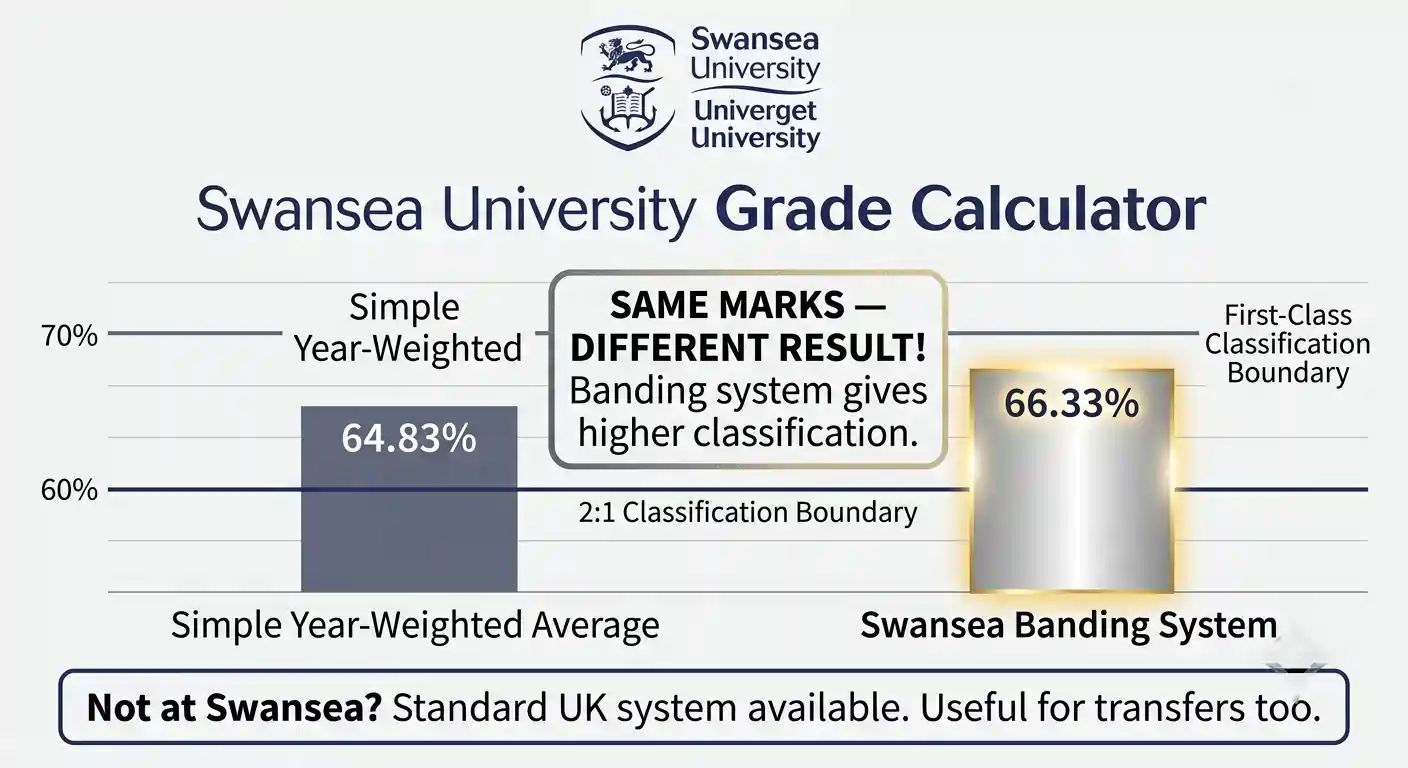
Compare that to what a simple 1:2 Level 5:Level 6 weighted average would give using the same marks: your raw Level 6 average is 68.17%, your raw Level 5 average is 58.17%, and (58.17 × 1 + 68.17 × 2) ÷ 3 = 64.83%. The banding system gives 66.33% — a point and a half higher, because it credits your best Level 5 modules at the higher Band 2 weight instead of letting them sit at a flat Level 5 rate.
Borderline cases: two separate rescue principles
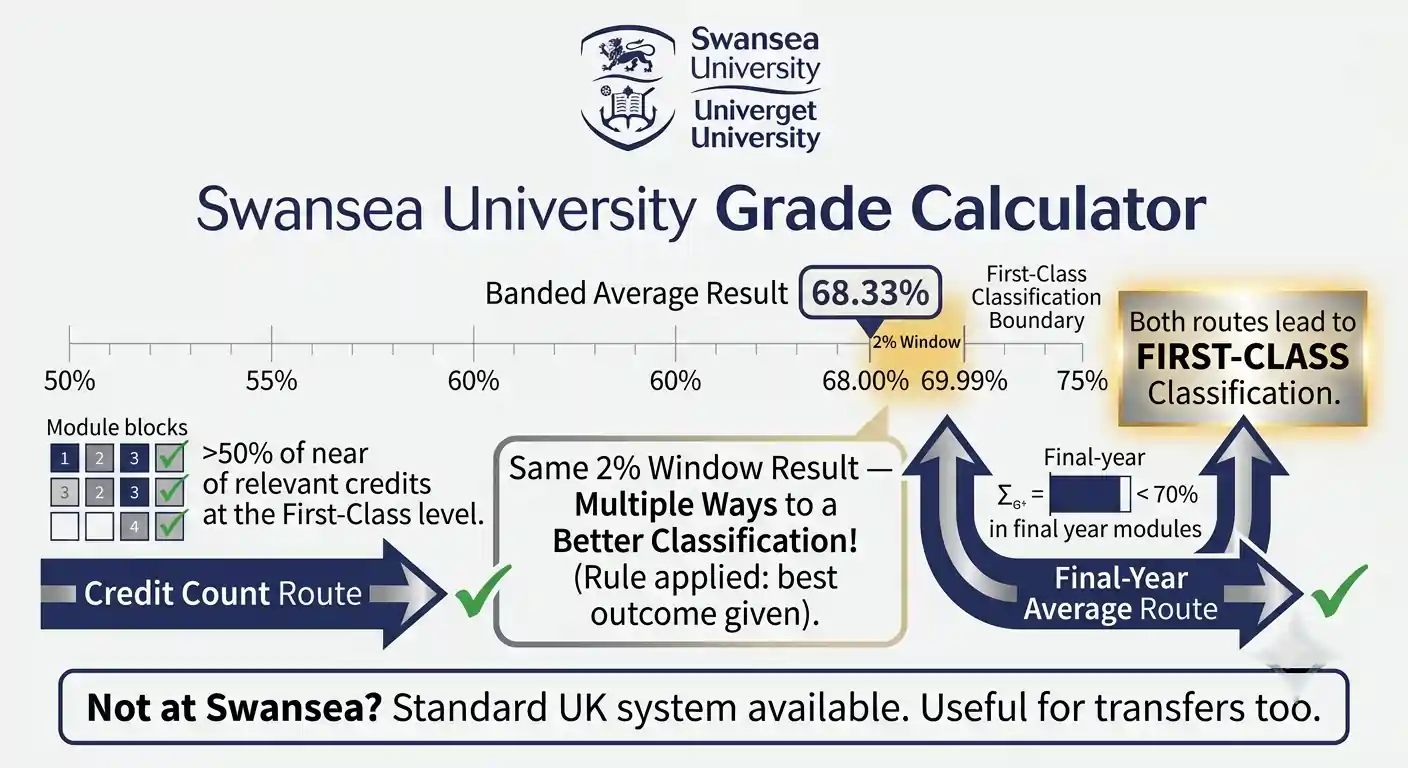
If your banded average falls within 2% of a classification boundary, Swansea calls this the "window of opportunity" — two separate principles can raise your classification. Under the Preponderance Principle, you're awarded the higher classification if 120 or more of your 240 classified credits were individually marked at or above that higher band.
Under the Exit Velocity Principle, examiners instead look at your unweighted final-year average alone; if that average sits in the higher band, you're normally awarded the higher classification on that basis instead.
Studying abroad or on an industrial placement?
If your course includes a year abroad, Swansea adds a fourth band, Band S, for the marks from that year, but only uses it if doing so actually helps you. Specifically, if your year-abroad mark is better than your Level 5 average, your Level 5 contribution is recalculated as 75% Level 5 marks plus 25% year-abroad marks, blending the two rather than replacing one with the other.
If incorporating Band S wouldn't improve your result, the standard three-year banding formula above applies instead, with the year abroad simply not counted. An industrial placement year works differently again — it's normally assessed pass/fail and doesn't contribute to your classification calculation at all, regardless of how well you did on it.
What this calculator doesn't cover
Professionally accredited engineering programmes and physics programmes (for students joining from 2025/26) use a simpler system instead — Level 6 marks weighted ×2 and Level 5 marks weighted ×1, with no banding by performance at all.
Four-year "Advanced Initial Degrees" use a four-band version of this system instead of three bands, and programmes including a year abroad or in industry adjust the bands further, only applying if doing so works in the student's favour.
This calculator is built around the standard three-year initial degree banding system; check your own programme regulations if any of these apply to you.
Frequently asked questions
Why isn't this just a weighted average by year?
Because Swansea sorts credits into performance bands rather than weighting by level alone, your best Level 5 marks can end up weighted more heavily than your weaker Level 6 marks, which a simple year-weighted average wouldn't capture.
Does this apply to engineering or physics students?
Not directly. Professionally accredited engineering programmes and physics programmes for students joining from 2025/26 use a simpler two-band, level-only system instead of the full banding system this calculator is built around.
What's the 2% "window of opportunity"?
If your banded average falls within 2% of a classification boundary, the Progression and Awards Board considers whether the Preponderance or Exit Velocity Principle would raise your classification, rather than relying on the banded average alone.
What if I was admitted directly into the final year?
Direct entry to the final year uses a single weight of 1 across all 120 credits pursued, rather than the full Band 1/2/3 system — a much simpler calculation than the standard route.
Can I just use the generic degree classification calculator instead?
Not reliably — the generic degree classification calculator applies a single weighted average and wouldn't capture Swansea's banding system, which can move your result by more than a single percentage point either way, as the worked example above shows.