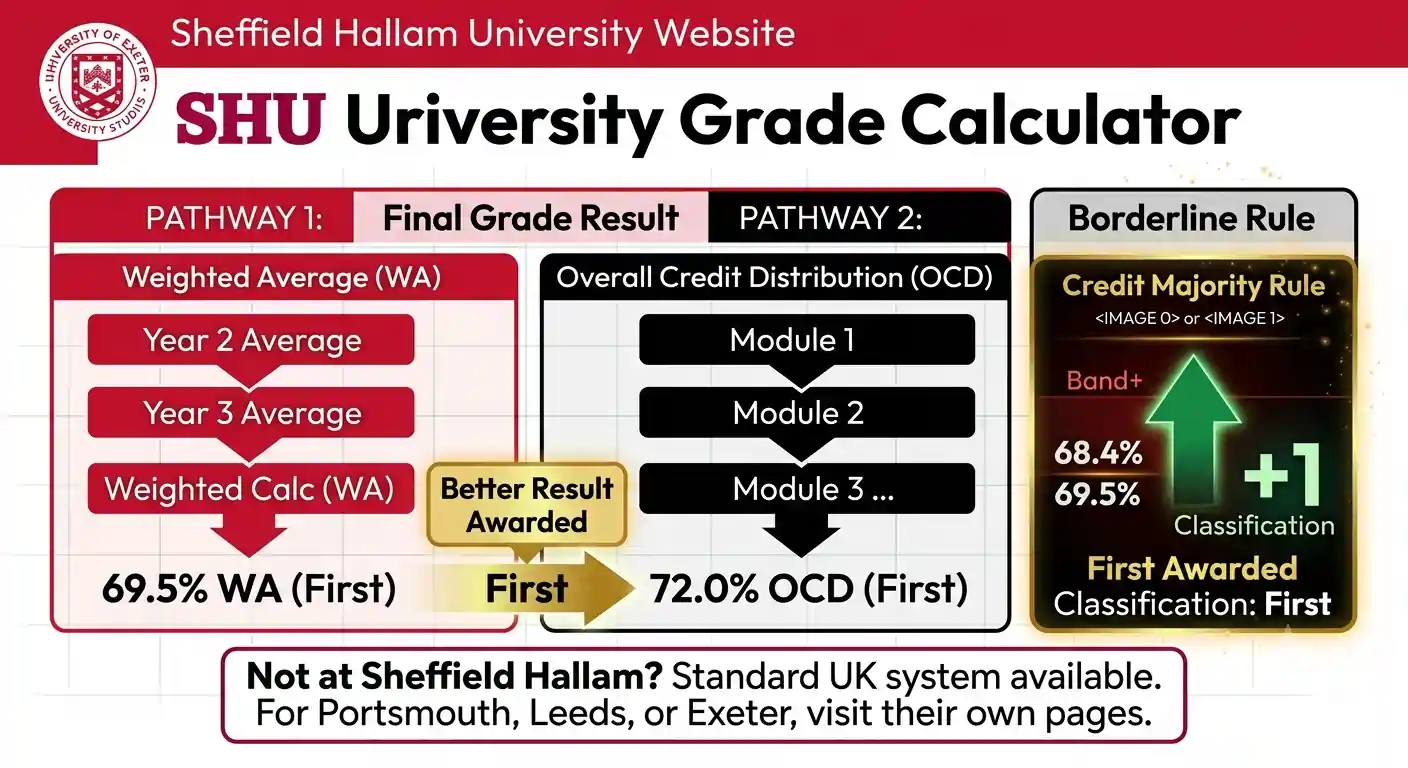
If you're not at Sheffield Hallam, the degree classification calculator covers the standard system most other universities use instead. If you're at one of the other universities we've covered — like Portsmouth, Leeds, or Exeter — head to that institution's own page instead; each one runs on a genuinely different formula.
Method 1 and Method 2: the two ways your degree is calculated
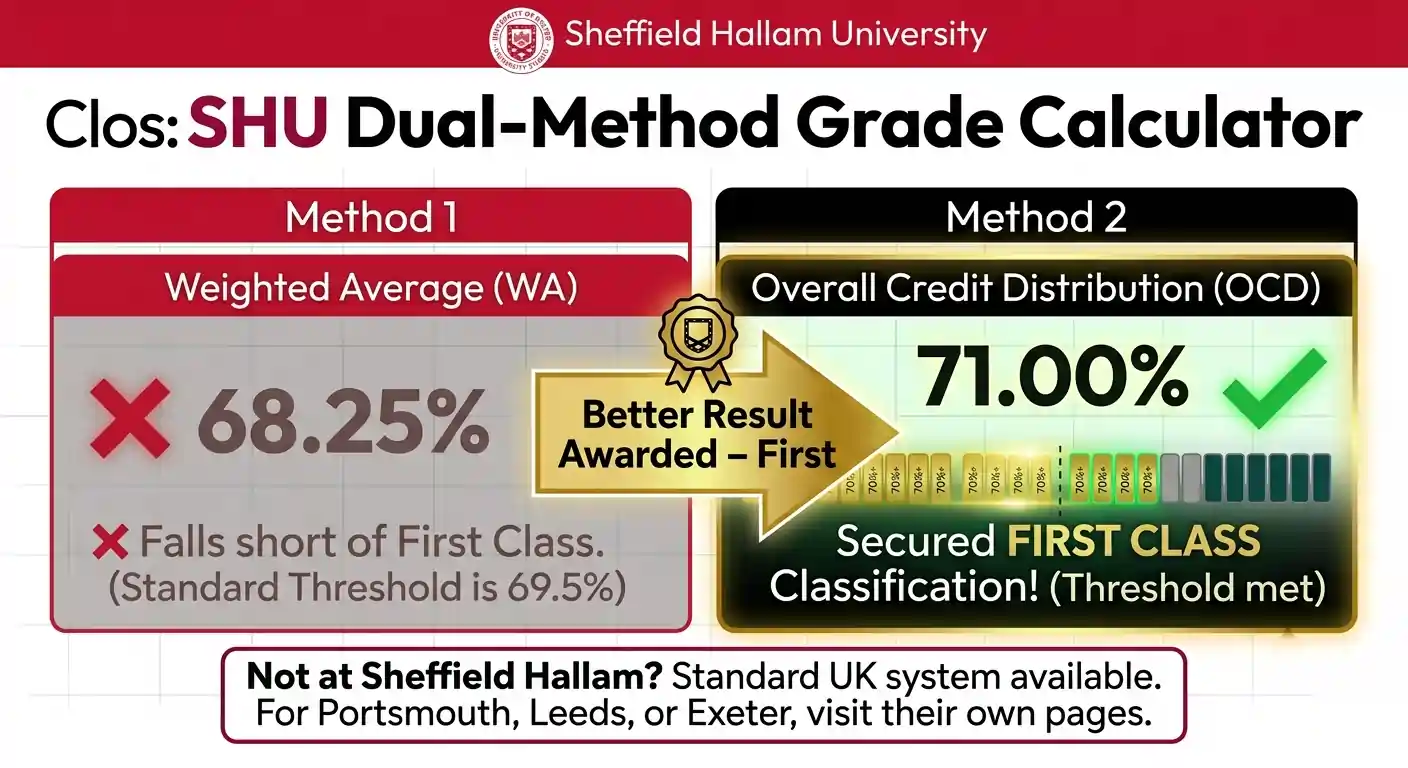
Sheffield Hallam runs two separate calculations and gives you the better outcome automatically. Method 1 weights Level 5 at 25% and Level 6 at 75%. Method 2 ignores Level 5 entirely and uses Level 6 on its own.
Note that this is a different weighting from some other universities' "final year counts more" rules. Hallam's 25:75 split is steeper toward the final year than most, and Method 2 goes further still by dropping Level 5 from the calculation altogether.
An important date: what changes from 2 November 2026
For students confirming results before 2 November 2026, both methods are calculated using only your best 100 credits out of the 120 at each level — your weakest 20 credits at each level are set aside before the average is taken. For students confirming results from 2 November 2026 onward, that discount is removed entirely, and both methods use the full 120 credits at each level. If you're using this calculator now, check which side of that date your result falls on, since it changes the numbers going into both methods.
Worked example: Method 2 beating Method 1
Using the full-120-credit version of the rules (the standard from November 2026 onward): say your Level 5 average is 60% and your Level 6 average is 71%.
Method 2 gives the higher result, so you'd be awarded a First-Class result on the strength of your final year alone, even though Method 1 — factoring in a weaker second year — would only have given you a 2:1.
How the pre-2026 credit discount changes the numbers
If your result is confirmed before 2 November 2026, both methods above are run on your best 100 credits out of 120 at each level, not the full 120. Concretely: if one of your six 20-credit Level 6 modules scored noticeably lower than the rest, that module's credits are set aside before the Level 6 average is calculated, and only the remaining 100 credits count.
This can move your Level 6 average up compared to including every module, which then feeds into both Method 1 and Method 2 — so the same set of marks can produce a different result depending purely on which side of the November 2026 date your award falls.
The borderline First-Class check
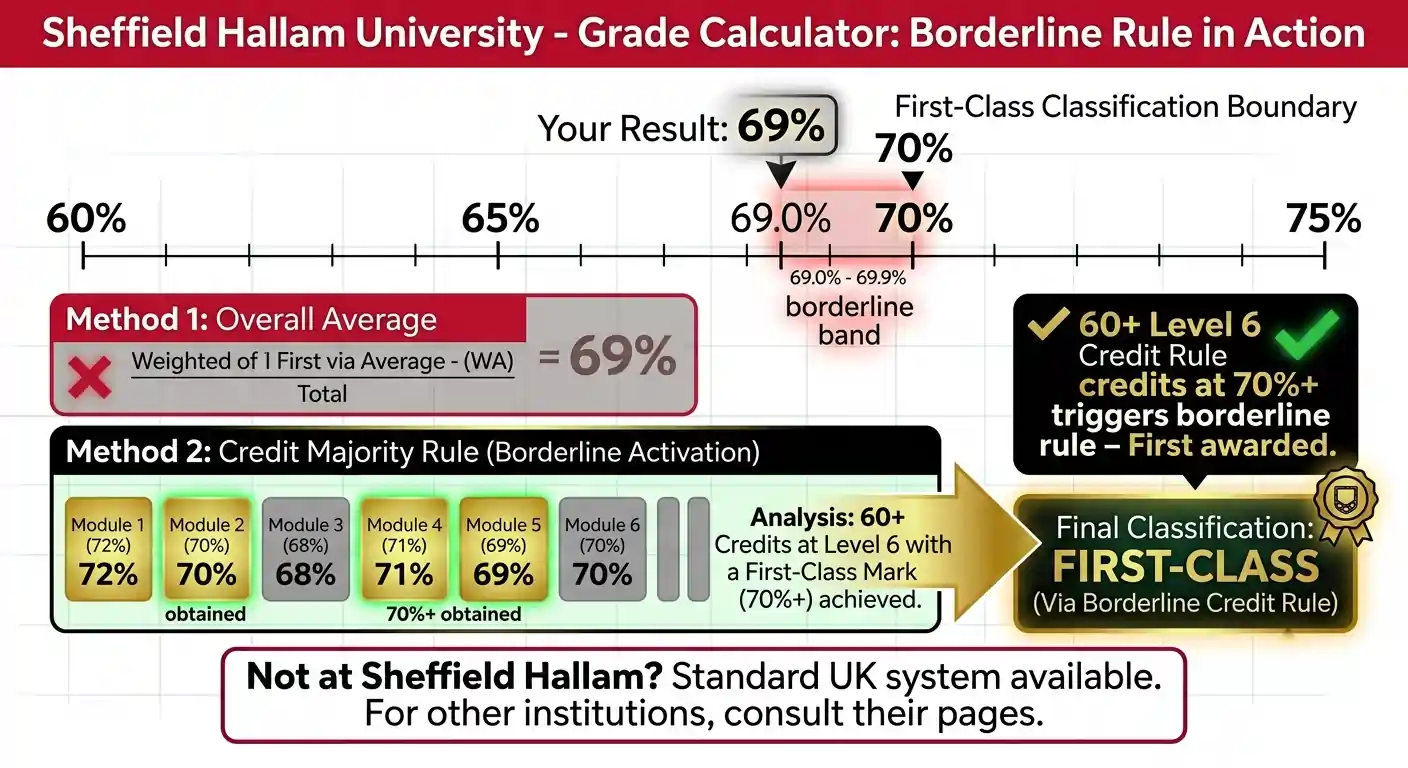
On top of Method 1 and Method 2, Hallam's regulations have included a specific rule for results that land just under the First-Class line: if your final mark falls in the 68.01–69.99% borderline band, and at least 60 of your Level 6 credits were individually marked at First-Class level (70% or above), you're awarded a First outright.
This means a result of, say, 69% under Method 2 — which on its own reads as a 2:1 — can still become a First if half or more of your Level 6 modules individually cleared 70%, regardless of what your headline average says. Always confirm this specific rule is still active in your year's regulations, since assessment rules are reviewed periodically.
What this calculator doesn't cover
Integrated Master's degrees use a different structure entirely — Method 1 weights Level 6 at 25% and Level 7 at 75%, while Method 2 spreads weighting across Level 5 (20%), Level 6 (30%), and Level 7 (50%).
Recognised Prior Learning credit also has specific restrictions: only credit actually awarded by Sheffield Hallam counts toward a Merit or Distinction outcome, even if other credit contributes to the overall award. This calculator is built around the standard three-year Bachelor's structure; check your own course regulations if either of these applies to you.
Frequently asked questions
Which method will I actually be awarded under?
Whichever of Method 1 or Method 2 gives the higher result — the Assessment Board selects and verifies this automatically; you don't need to request it.
Does the credit discount still apply to me?
Only if your results are confirmed before 2 November 2026 — after that date, both methods use your full 120 credits at each level with no discount. Check which applies to your award.
What's the borderline First-Class rule, exactly?
If your final mark sits between 68.01% and 69.99% and at least 60 of your Level 6 credits were individually marked 70% or above, you qualify for a First despite the headline average reading as a 2:1.
Does this work for Integrated Master's degrees?
Not directly — Integrated Master's awards use a different weighting across Levels 6 and 7 (or 5, 6, and 7), rather than the Level 5/6 structure this calculator is built around.
Can I just use the generic degree classification calculator instead?
Not reliably — the generic degree classification calculator doesn't run Method 1 and Method 2 separately and would miss both the Level-6-only route and the borderline credit check.
Why does Hallam weigh Level 6 so much more heavily than Level 5?
A 75% weighting on Level 6 under Method 1, and 100% under Method 2, reflects a deliberate emphasis on your most advanced, final-year work over your second year.
This is steeper than many UK universities' year weightings, so a strong final year can carry real weight here even if your second year was a weaker one.