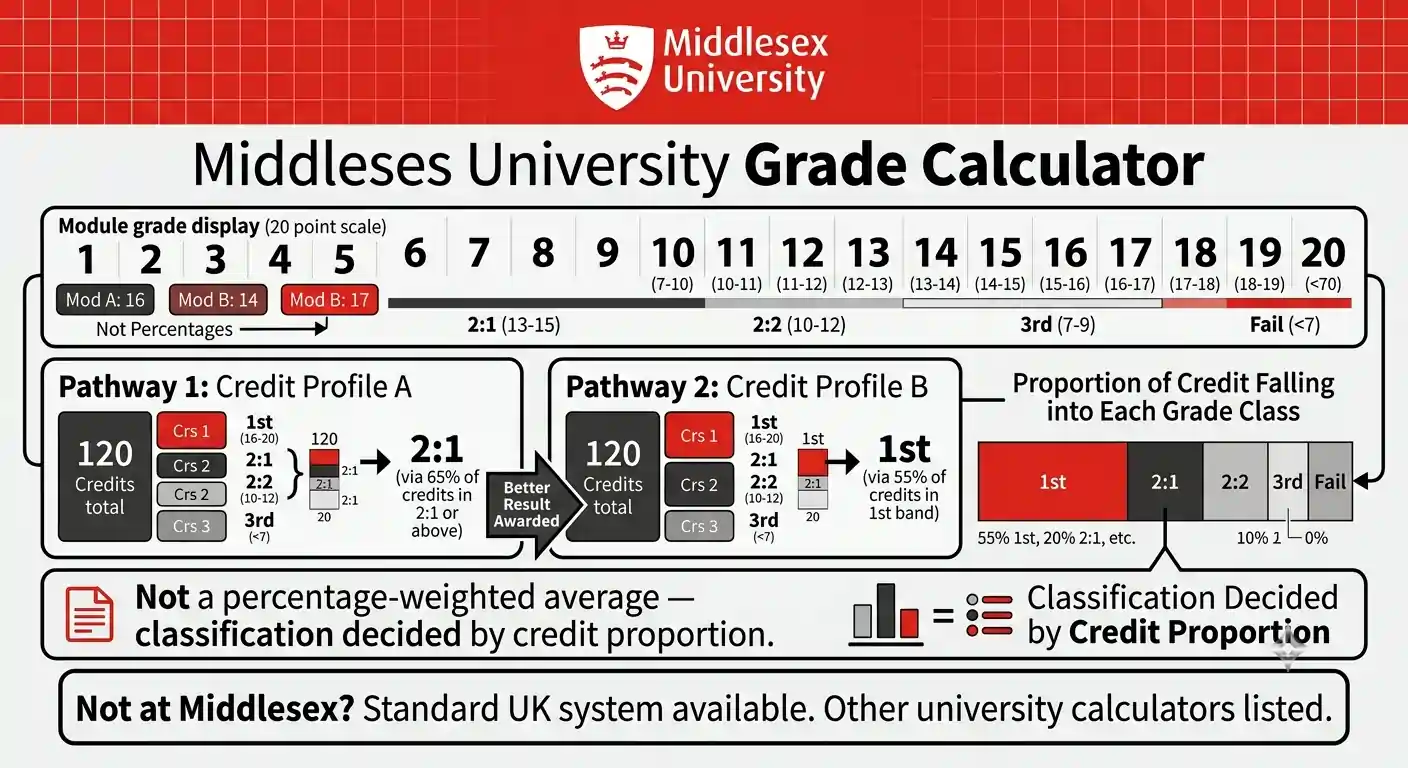
If you're not at Middlesex, the degree classification calculator covers the standard percentage-based system most other universities use instead.
The 20-point scale, and how it maps to a classification
Every Middlesex module is graded 1 to 20, where 1 is the best result and 20 the weakest. Percentage marks convert onto this scale on a published table: 80–100% is a grade 1, 76–79% a grade 2, 73–75% a grade 3, and 70–72% a grade 4 — already four separate grades inside what other universities would just call "70 and above." Moving down: 67–69% is a grade 5, 60–61% a grade 8, 50–51% a grade 12, and 40–41% a grade 16, with anything below 35% failing outright.
Those 20 points then group into the classifications you'd recognise: grades 1–4 map to a First, 5–8 to an Upper Second (2:1), 9–12 to a Lower Second (2:2), and 13–16 to a Third. The scale is deliberately finer at the top end; there's more room to distinguish a 90% from a 75% than there is lower down, where the bands widen out.
Classification by credit distribution, not by averaging
This is the part that makes Middlesex genuinely different: your classification isn't decided by averaging your grades at all.
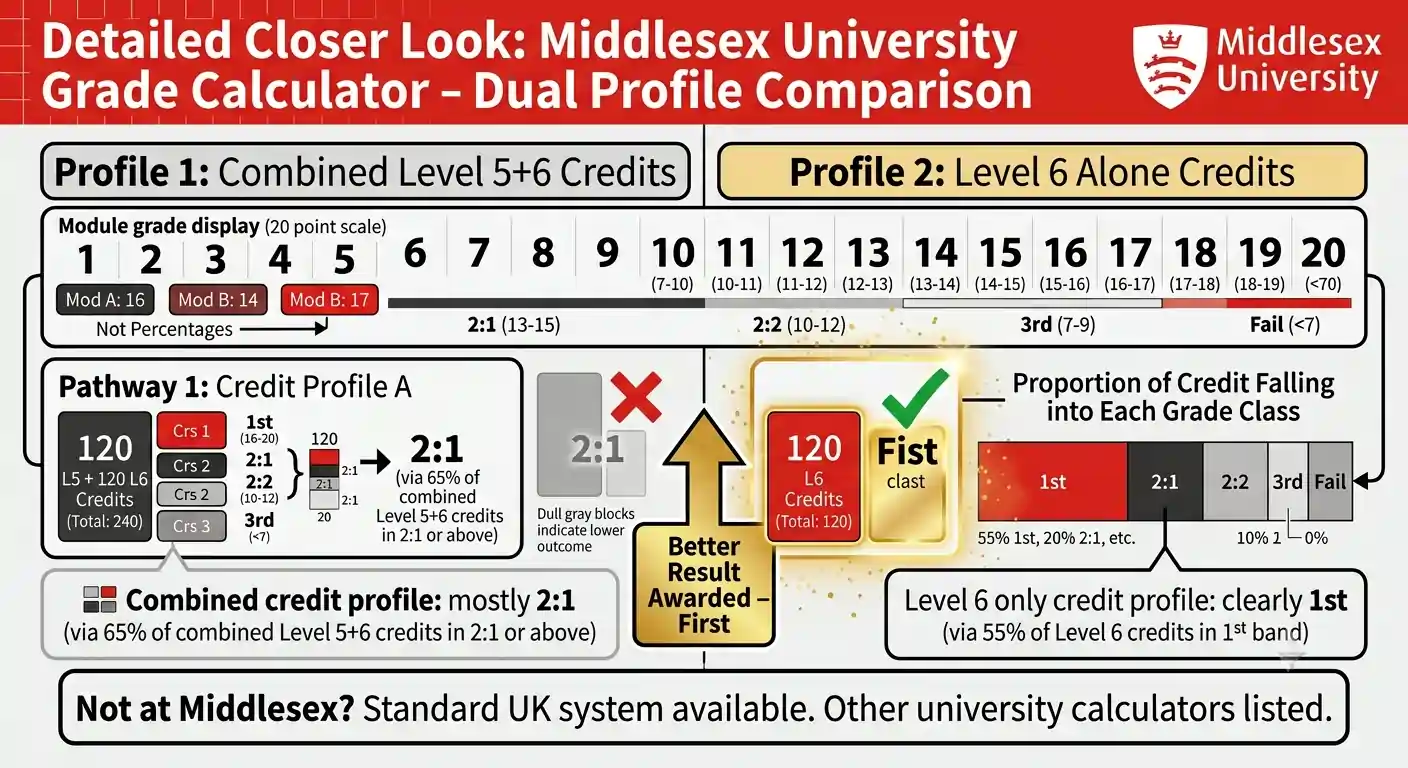
Instead, the university checks what proportion of your graded credit falls into each classification band, across two separate profiles — all your passed credit at Level 5 and above, and all your passed credit at Level 6 and above — and you need 50% or more of that credit (at the class you're being considered for, or higher) to be awarded that class. Middlesex checks both profiles and awards you whichever gives the better outcome.
Worked example: when your final year alone secures a better result
Say your four Level 6 modules (30 credits each) scored 85%, 82%, 71%, and 69%. Converted to the 20-point scale, that's grades 1, 1, 4, and 5 — three modules (90 credits) in the First band and one module (30 credits) in the 2:1 band. Checked on its own, that's 90 of 120 Level 6 credits — 75% — in the First band, comfortably clearing the 50% threshold for a First.
Now say your four Level 5 modules scored 55%, 52%, 48%, and 40% — grades 10, 11, 13, and 16 — putting 60 credits in the 2:2 band and 60 credits in the Third band, with nothing in the First or 2:1 bands at all.
Combine both years (240 credits total): First-band credit is still just the 90 from Level 6 — 37.5% of the combined total, short of the 50% needed for a First. But credit at 2:1-or-above reaches 120 of 240, exactly 50%, which is enough for a 2:1. So the combined Level-5-and-above profile gives a 2:1, while the Level-6-and-above profile alone gives a First. Middlesex awards whichever is better — in this case, the First, on the strength of final year alone.
What happens to a compensated or marginal fail?
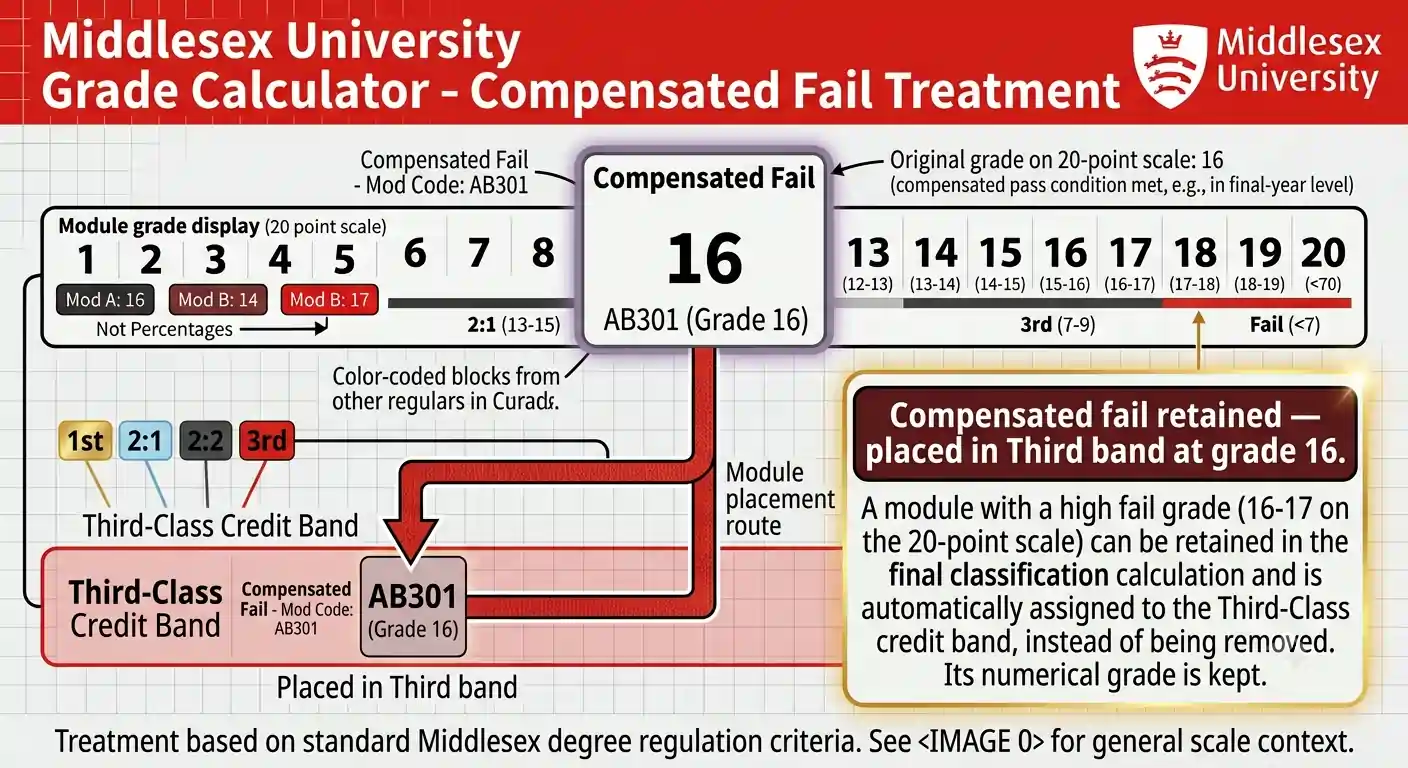
Middlesex allows some failed modules to be compensated rather than requiring a resit, at the discretion of the Assessment Board. For classification purposes specifically, a compensated grade is placed at the bottom of the Third-class band rather than being excluded from the calculation entirely.
If you're relying on a compensated module, it's worth knowing it still counts toward your credit distribution, just at the lowest passing band.
What this calculator doesn't cover
If neither of the two profiles clearly reaches 50% or more in a class — a genuinely borderline case — Middlesex's Assessment Board reviews the case further, taking your performance in your final stage of study into account alongside the formal credit-distribution rules.
That kind of holistic review isn't something a calculator can model. Integrated Master's students have a third profile (Level 7 and above) added to the same logic, which this calculator doesn't include.
Frequently asked questions
Why doesn't this calculator just average my percentage marks?
Because Middlesex doesn't classify degrees by averaging at all — it converts marks to a 20-point grade scale and classifies based on what proportion of your credit sits in each grade band, not a mean mark.
What are the two profiles checked?
All your passed credit at Level 5 and above (your second and third year combined) and all your passed credit at Level 6 and above (your final year alone). You're awarded whichever profile gives the better classification.
Does a compensated fail count against me?
It counts toward your credit distribution at the bottom of the Third-class band (grade 16), rather than being excluded, so it does affect your credit proportions — just not as harshly as an uncompensated fail would.
What if I'm doing an Integrated Master's?
This calculator is built around the standard two-profile undergraduate system. Integrated Master's students have a third profile added, covering Level 7 credit, which isn't included here — check your specific course regulations.
Can I just use the generic degree classification calculator instead?
Not reliably — the generic degree classification calculator assumes a percentage-weighted average, which isn't how Middlesex classifies degrees at all.
Why is the 20-point scale so much finer at the top end?
Middlesex's table gives four separate grades (1 through 4) to the percentage range that other universities would simply call "first-class," compared to wider bands lower down the scale.
This gives more precision at the top of the range, where the difference between a strong first and an exceptional one is harder to capture with a single percentage cut-off.