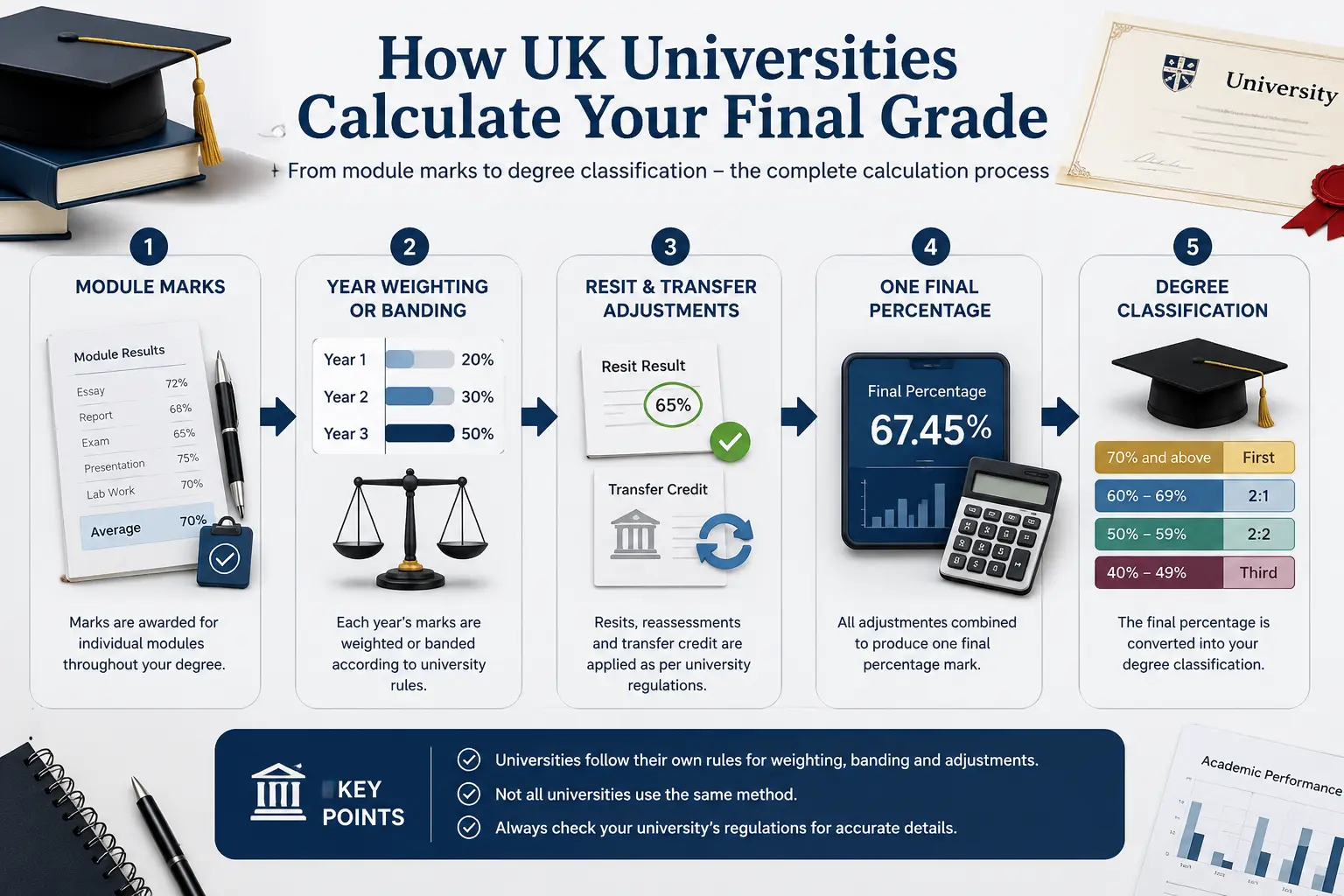
It's the step that happens before classification: our classification guide picks up from here to explain how that final percentage becomes a First, 2:1, 2:2, or Third.
Step 1: Which years actually count?
Across every university we've verified — Portsmouth, Leeds, Exeter, Sheffield Hallam, Swansea, and Middlesex — first year (Level 4) is excluded from the final grade calculation entirely. It's used to confirm you can progress, but none of it feeds into your overall result. This is close to universal across UK universities, though it's always worth confirming for your specific course, since accredited professional programmes occasionally apply different rules.
Step 2: How much does each remaining year count?
This is where things genuinely diverge. Some universities use a clean, fixed ratio between years; others don't use a ratio at all.
| University | Year weighting |
|---|---|
| Portsmouth | 40% Level 5, 60% Level 6 |
| Leeds | 33.3% Year 2, 66.7% Year 3 (fixed since 2022/23) |
| Exeter | 33.3% Stage 2, 66.7% Stage 3 |
| Sheffield Hallam | 25% Level 5, 75% Level 6 (or Level 6 alone, whichever is higher) |
| Swansea | No fixed ratio; credits are sorted into performance bands instead |
| Middlesex | No weighting at all — classification is based on credit distribution, not an average |
Two universities share an identical 1:2 ratio (Leeds and Exeter) despite having otherwise different rules layered on top — proof that the ratio alone doesn't tell you everything about how a university actually treats your result.
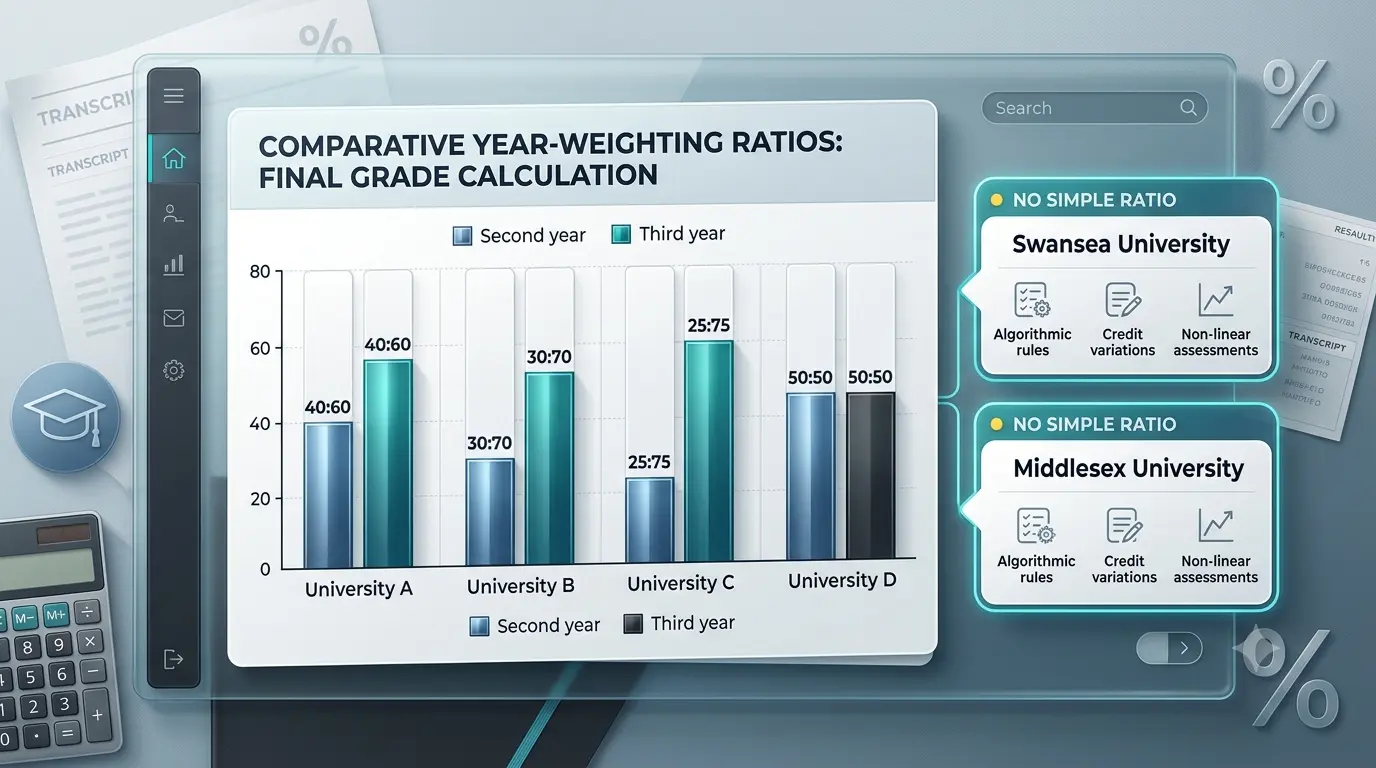
Worked example: identical marks, different results
Say a student averaged 60% in their second year and 70% in their final year, with identical inputs, run through four different universities' ratios. At Portsmouth (40:60): (60 × 0.4) + (70 × 0.6) = 66%. At Leeds or Exeter (33.3:66.7): (60 × 0.333) + (70 × 0.667) = 66.67%.
At Sheffield Hallam (25:75, Method 1): (60 × 0.25) + (70 × 0.75) = 67.5%, though Method 2 would actually give this student 70% outright, since it uses Level 6 alone and 70% beats 67.5%. Four genuinely different results, from exactly the same two marks, purely because of which university's formula applies.
Step 3: What happens to resits and failed modules?
If you resit a failed module, whether your real resit score counts in full depends on your university. Swansea explicitly caps resit and repeat marks at 40% for Levels 5, 6, and S and at 50% for Level 7, regardless of how well you actually did on the resit, so the mark used in your final grade calculation can be lower than your genuine performance.
Separately, some universities allow "condonement," letting a limited number of failed credits still count toward your award without a resit at all, as Exeter does, provided those credits are genuinely contributing to your qualification. These are two different mechanisms solving different problems: a resit cap limits how much credit a second attempt can earn you, and condonement avoids the resit altogether for borderline failures.
Step 4: What about transferred credit and placement years?
Credit from another institution, recognised prior learning, or a year abroad is handled differently depending on where you study; some universities exclude it from your final grade calculation entirely, and others blend it in only if doing so helps you. We've covered this in full, with specific examples from Leeds, Middlesex, and Sheffield Hallam, in our credit system guide — worth reading in full if any of this applies to you, since the details genuinely change the calculation.
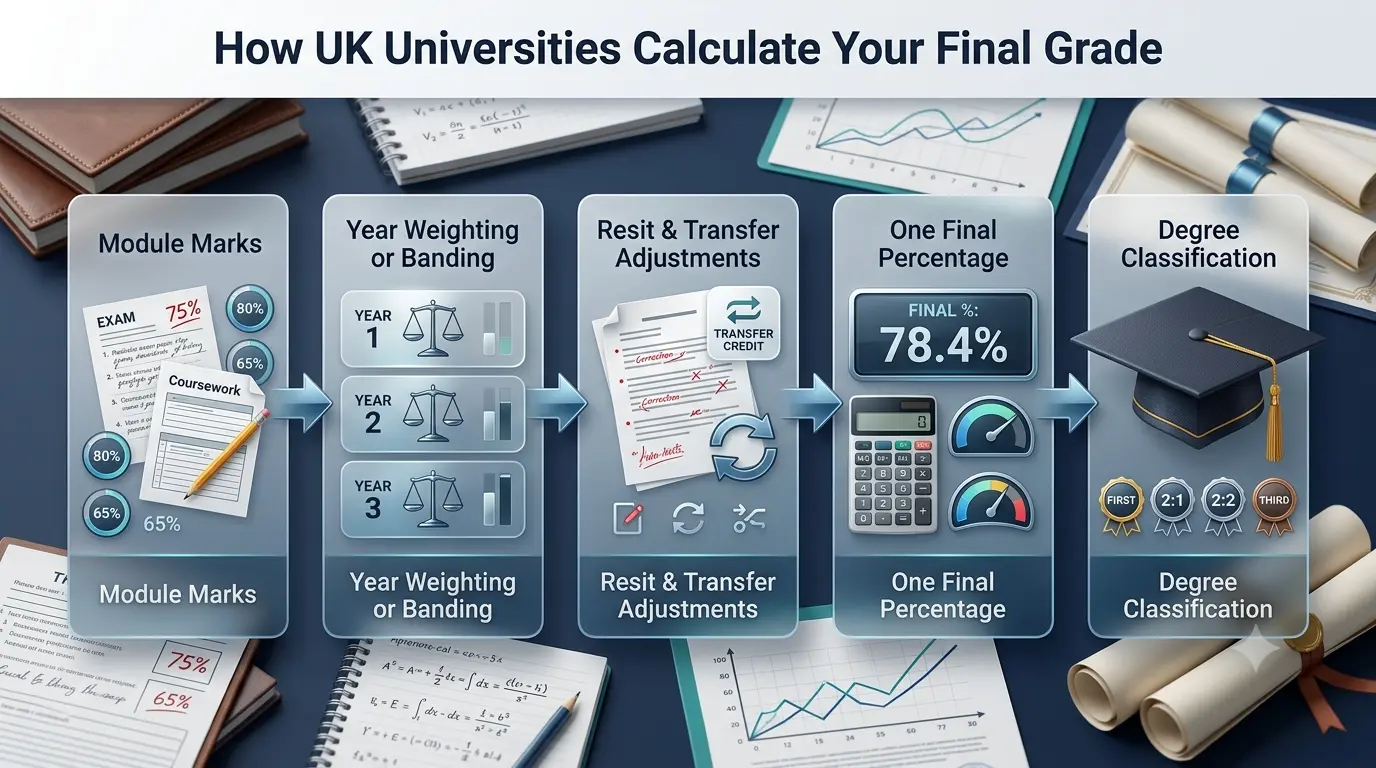
Putting it together
The overall process, in order, looks roughly like this: start with your individual module marks; apply your university's year weighting, banding, or credit-distribution method; adjust for any capped resits, condoned failures, or excluded transfer credit; and you arrive at one final percentage (or, for Middlesex, a credit profile rather than a percentage at all). That final number is what then gets compared against classification boundaries, which is where our classification guide and the degree classification calculator pick up.
If your university is one of the six we've verified, use its dedicated calculator for an accurate result; if not, the university grade calculator and final and overall grade calculator give you the standard-method estimate.
Frequently asked questions
Does the first year really not count anywhere?
Among the six universities we've verified, no — first year is universally excluded from the final grade calculation, though it's still worth confirming for your own specific course, especially if it carries professional accreditation requirements.
Why do weighting ratios differ so much between universities?
There's no UK-wide standard for how a university weights its years; each institution sets its own assessment regulations, which is why the six examples above range from a fixed 25:75 split to no fixed ratio at all.
What's the difference between a resit cap and condonement?
A resit cap limits the mark a resit module can contribute, regardless of your actual performance on the resit. Condonement lets a limited number of failed credits count toward your award without resitting them at all. They solve different problems and don't always both apply at the same university.
Where can I find my own university's exact rules?
Your assessment regulations or academic handbook, usually published by your registry or student records office, will have the exact formula. If your university isn't one of the six we've verified, that's the most reliable source — more reliable than any calculator that hasn't confirmed your specific rules.
Which calculator should I actually use?
If we've built a calculator for your specific university, use that one. If not, start with the university grade calculator for your current average or the final and overall grade calculator if you're solving for a target.