This calculates your current average from credits you've already completed; the same as the main calculator, it doesn't solve "What do I need on what's left?" For that, use the final and overall grade calculator, which supports credit weighting too.
How UK credit structures actually work
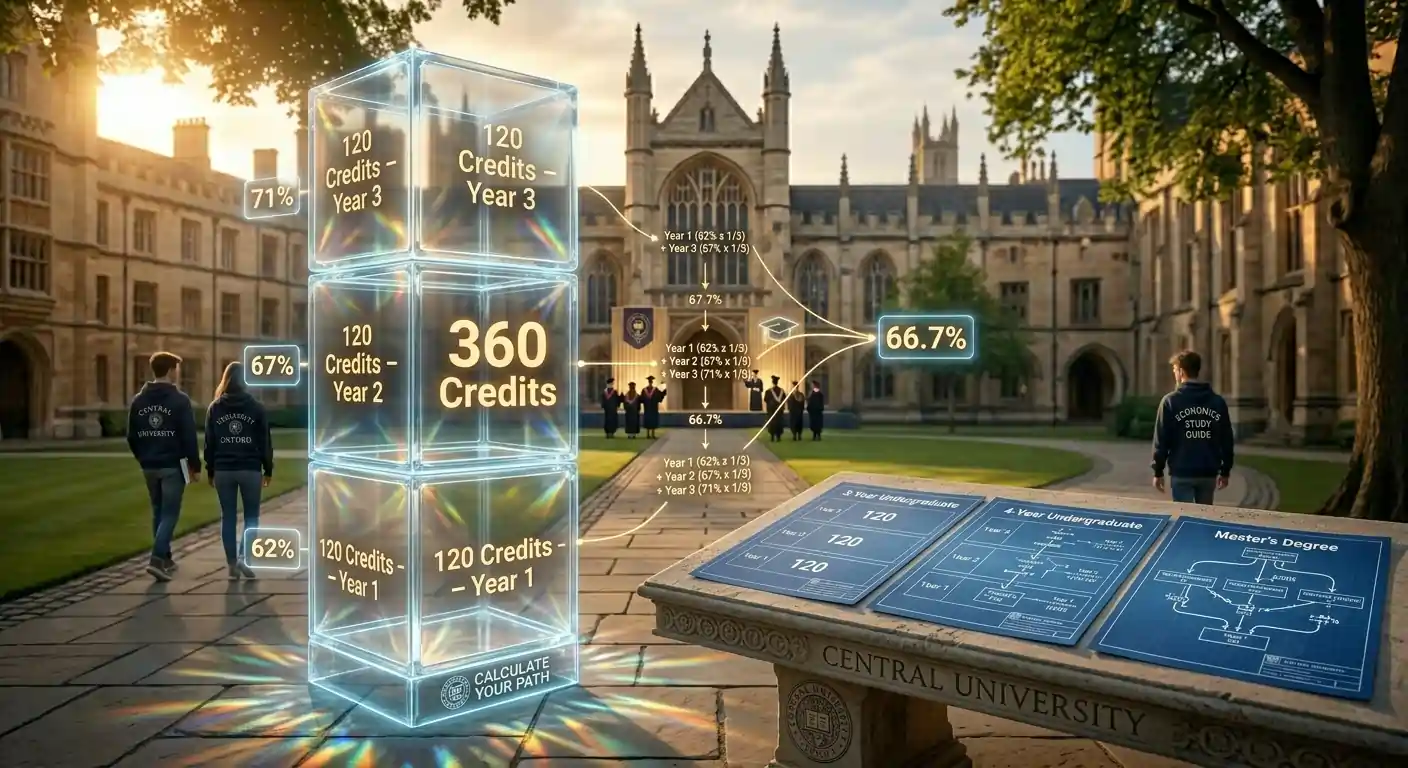
Most UK undergraduate degrees are built from 120 credits per year, split across modules. A standard three-year honours degree totals 360 credits; four-year courses (integrated master's, or many Scottish degrees) total 480. Each year also has a level: the first year is Level 4, the second year is Level 5, the third year is Level 6, and the fourth year (where one exists) is typically Level 7.
Postgraduate master's degrees use a different total: 180 credits, almost always completed in a single year. That's commonly split as 120 credits of taught modules plus a 60-credit dissertation, though the exact split varies by course.
Worked example: undergraduate, Level 5 vs Level 6
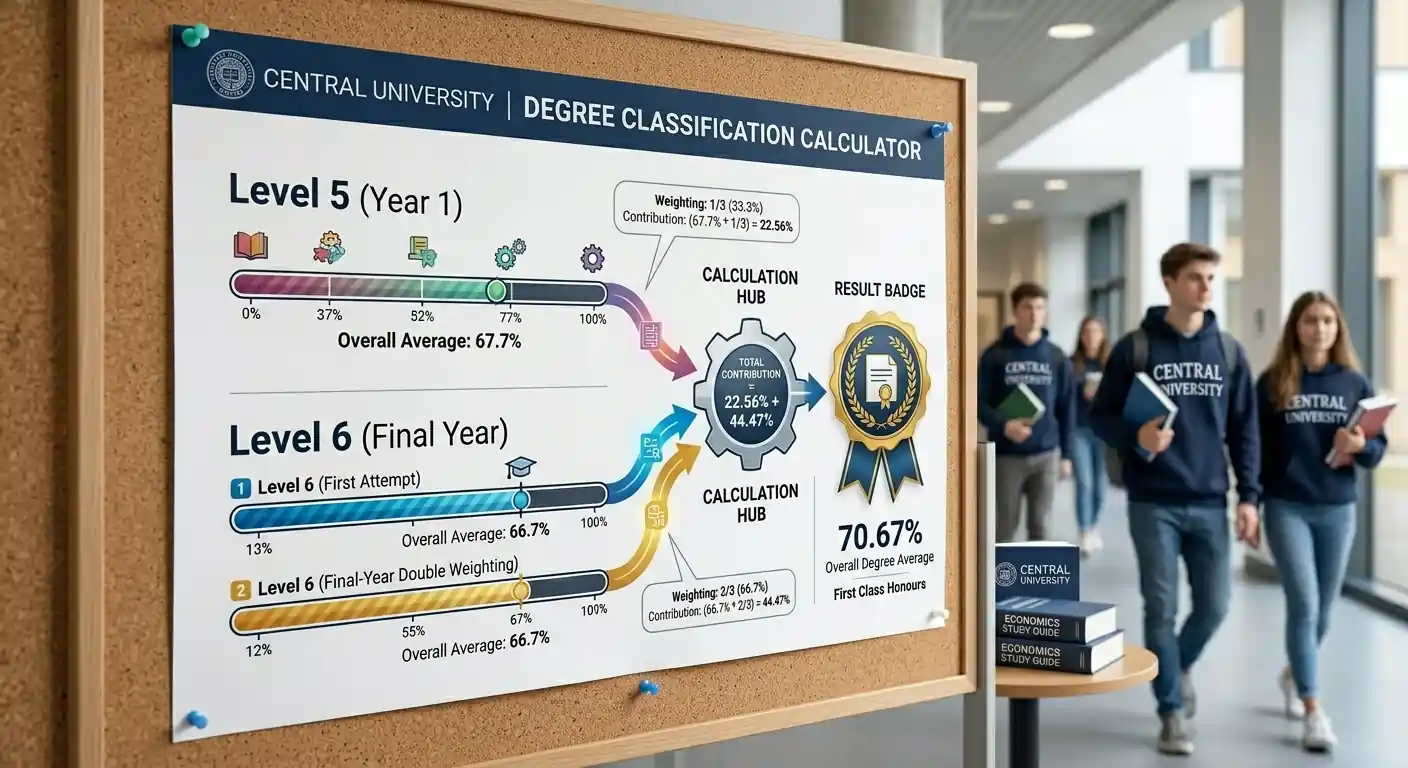
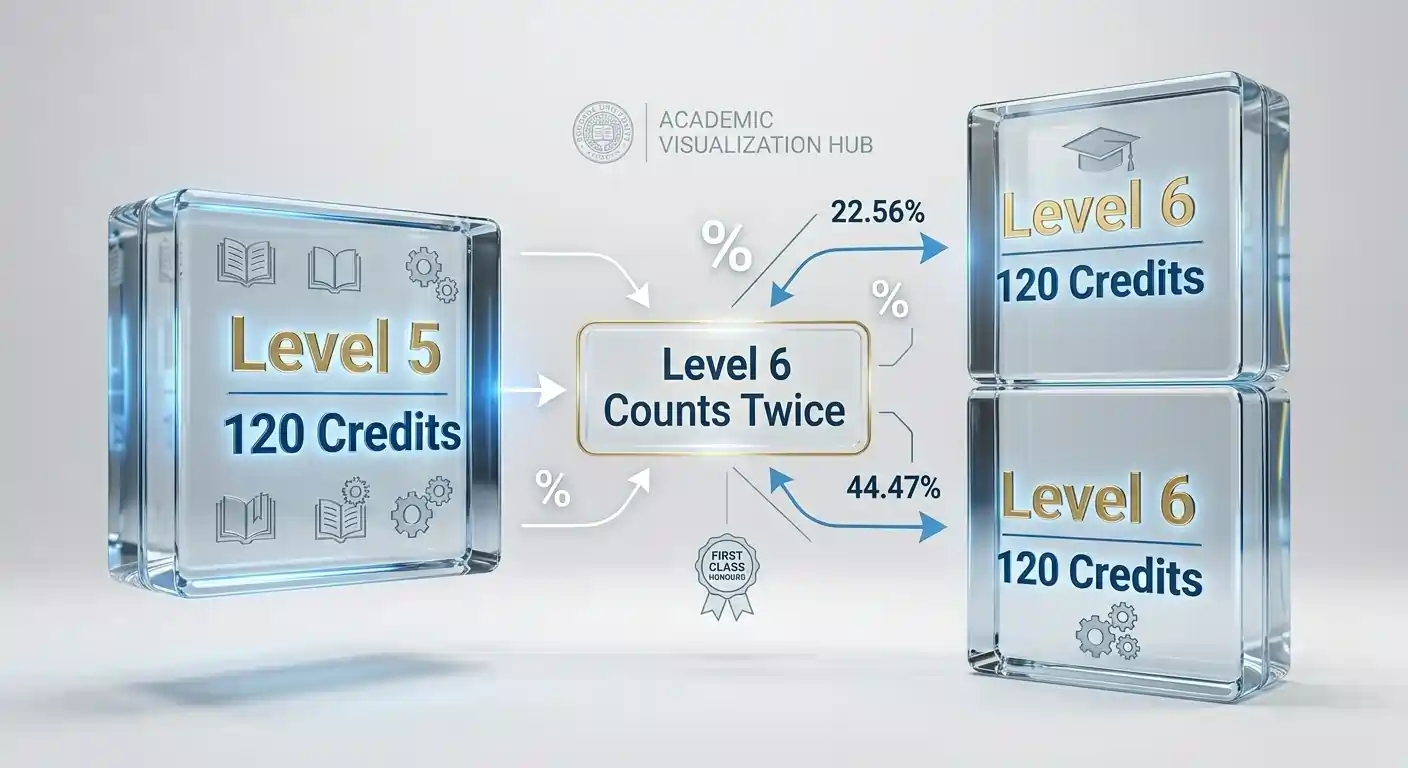
Say you averaged 62% across Level 5 (second year, 120 credits) and 75% across Level 6 (third year, 120 credits). If you simply weighted by raw credits, both years would count equally, 50:50, since they're both 120 credits. But many universities weight final year more heavily than that for classification purposes, commonly doubling its effective weight.
Using a 1:2 weighting between Level 5 and Level 6: effective weighted credits are 120 for Level 5 and 240 for Level 6 (120 × 2), giving 360 total.
Worked example: a 180-credit master's
Say your taught modules (120 credits) averaged 68%, and your dissertation (60 credits) scored 75%. Credit-weighted average:
Notice the dissertation carries real weight here — a third of the total credits — even though it's a single piece of work rather than a set of modules. That's exactly the kind of structure a generic weighted-average grid won't set up for you automatically, which is the point of this page.
Why equal credits don't always mean equal weight
It's easy to assume that two years with the same number of credits must count equally toward your final result, but that's often not how UK universities actually do it — as the first worked example above shows, a university can give Level 6 double the influence of Level 5 even though both are 120 credits, simply by applying an extra weighting on top of the raw credit total.
This same logic shows up at classification boundaries too: rather than rounding a borderline average up or down by a strict cut-off, many universities look at how your credits are distributed across grade bands, so one or two weaker modules don't unfairly tip your final classification. The degree classification calculator covers exactly how that works.
What about four-year courses and integrated master's?
A standard three-year honours degree is 360 credits, but plenty of UK courses run longer. Integrated master's (an MEng or MSci built into the undergraduate degree rather than studied separately afterwards) typically run four years and total 480 credits, adding a Level 7 year on top of the usual Level 4, 5, and 6 structure.
The same is true for many Scottish degrees, where a four-year honours course is the norm rather than the exception.
The same weighting question applies here too: a fourth year doesn't necessarily count equally just because it's another 120 credits. Some universities weight Level 7 most heavily of all, on the basis that it represents your most advanced, most specialised work; others weight Levels 5, 6, and 7 more evenly.
There's no single UK-wide standard, which is exactly why checking your own course handbook matters more than relying on a general rule, ours or anyone else's.
Not sure how your university weights its levels?
Every university publishes this in a course or program handbook, usually under "degree classification" or "assessment regulations," and it's worth confirming rather than assuming, since the ratio between years varies (1:2 is common, but some universities use 1:3, or weight all years that count equally).
If you're trying to work out what average you need in a remaining year, rather than just checking your current standing, that's a target calculation the final and overall grade calculator handles — and it accepts credits as a weighting option, the same way this page does.
Frequently asked questions
Is this different from the main university grade calculator?
Yes. The main calculator is a blank grid where you enter any mix of percentages or credits yourself. This page is pre-structured around the standard UK credit system — 120 credits per level, 360 or 480 total for undergraduate, and 180 for a master's — so you don't have to set that structure up manually.
What's the difference between Level 4, 5, and 6?
They correspond to undergraduate years: Level 4 is first year, Level 5 is the second year, and Level 6 is third (final) year. A fourth year, where a course has one, is usually Level 7.
Does first year (Level 4) count toward my final grade?
At many UK universities, no — the first year is used to confirm progression but isn't included in the final classification calculation, with Level 5 and Level 6 carrying all the weight. This isn't universal, though, so check your own course handbook before assuming it.
How many credits is a UK master's degree?
Almost always 180 credits, typically completed in one year and commonly split as 120 credits of taught modules plus a 60-credit dissertation.
Can this tell me what average I need on the remaining credits?
No — this page shows your current credit-weighted average from completed levels. For "what do I need" calculations using credits as the weighting, use the final and overall grade calculator instead.