How this target calculation works
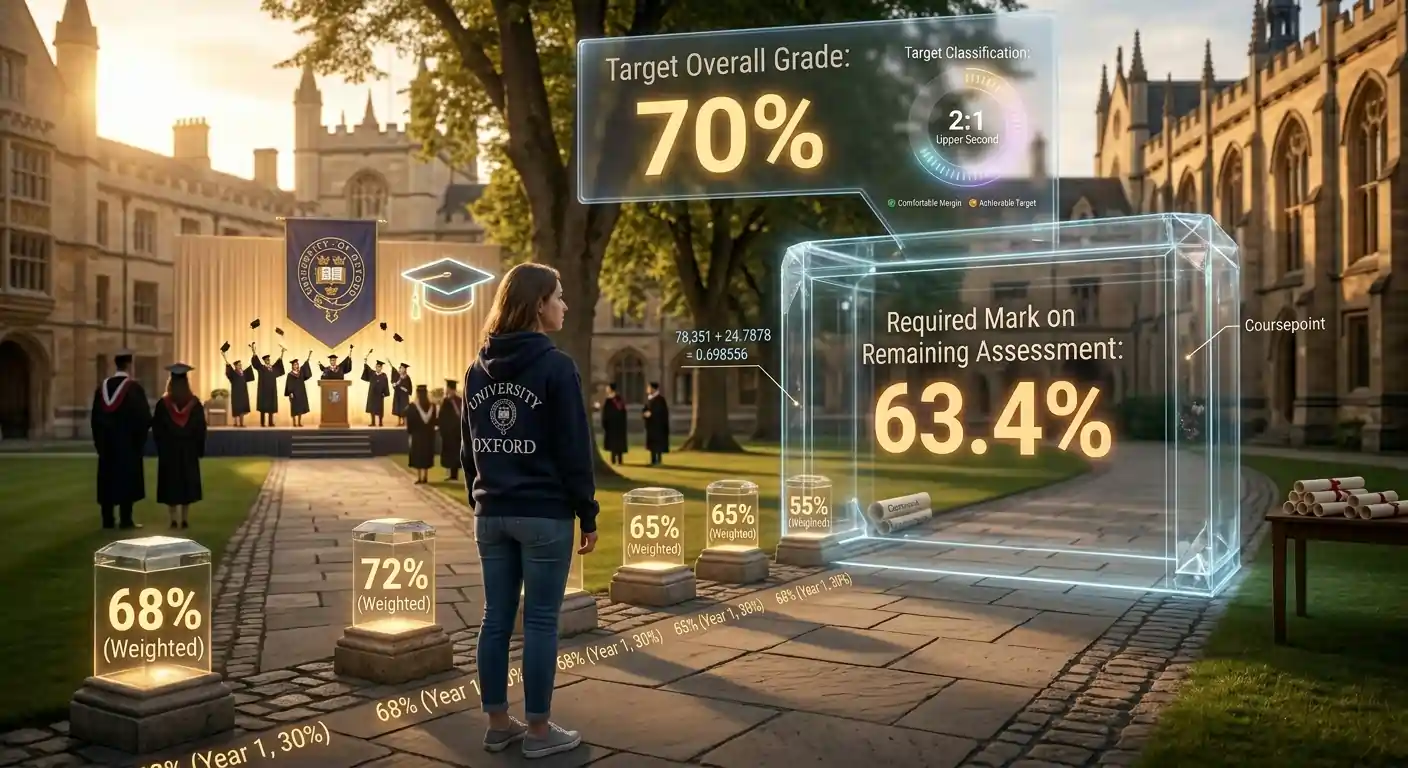
This calculator solves the reverse problem to the university grade calculator. Instead of asking "what is my average so far?", it asks: given my current average and how much of my degree is already banked, what do I need to average across everything that's left to hit a specific overall target?
Use percentage weightings or credits in the weight fields — the formula treats them identically, exactly as on the credit-weighted grade calculator. Common targets are the standard UK classification boundaries: 70% for a First, 60% for a 2:1, 50% for a 2:2, and 40% for a Third — see the degree classification calculator for how those bands work and how borderline cases are handled.
If you don't yet know your current average, work that out first with the university grade calculator, then come back here with the number.
Reading the result honestly
Treat the answer as a planning figure, not a promise. Your university's own regulations — year weightings, borderline rules, resit caps, and compensation — can move a real result in ways a single formula can't capture. Our guide to how UK universities calculate your final grade walks through exactly which of those rules matter and where they differ between institutions. If you're at Portsmouth, Leeds, Exeter, Sheffield Hallam, Swansea, or Middlesex, use that university's dedicated calculator for your overall classification, since each runs on a genuinely different formula.